




How AI and Data Analytics Are Reshaping Dam Inspections
AI, data analytics, and unmanned inspection systems are fundamentally changing dam safety. Inspections are no longer limited to visual confirmation, they are becoming measurable, comparable, and predictive.
Dam failures are rarely sudden. They are almost always preceded by slow, progressive deterioration, cracks, siltation, erosion, material loss, gate misalignment, corrosion, and scour. Most of these warning signs develop underwater, over years, in environments that are dark, confined, turbid, and unsafe for human access.
At the same time, more than half of the world’s large dams are now over 50 years old. Yet inspection cycles, tools, and reporting methods in many regions have not evolved at the same pace. As climate variability increases hydraulic stress on aging infrastructure, the gap between asset risk and inspection intelligence continues to widen.
This is where AI, data analytics, and unmanned inspection systems are fundamentally changing dam safety. Inspections are no longer limited to visual confirmation, they are becoming measurable, comparable, and predictive.
Why Traditional Underwater Inspections Fall Short
Diver-based inspections have long been central to dam maintenance, but real-world dam conditions impose clear limitations.
From field experience, the constraints are well understood:
-
Depth and safety limits restrict most dives to ~40 m and short working durations
-
Confined spaces such as tunnels, penstocks, and gate grooves are often inaccessible
-
Poor visibility, no light, and currents/suctions reduce inspection accuracy and often impossible
-
Observations are subjective, making year-on-year comparison difficult
-
Human risk exposure increases significantly in complex hydro environments
Even with experienced teams, diver inspections struggle to deliver consistent, repeatable, and measurable outputs.
In contrast, ROV-based inspections allow continuous operation, deeper access (often 300–450 m), and full digital documentation, without exposing personnel to risk.
The Shift: From Seeing to Measuring
Modern dam inspection is no longer about simply “looking underwater.”
It is about quantifying deterioration, measuring geometry, and assessing risk objectively.
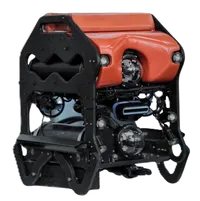
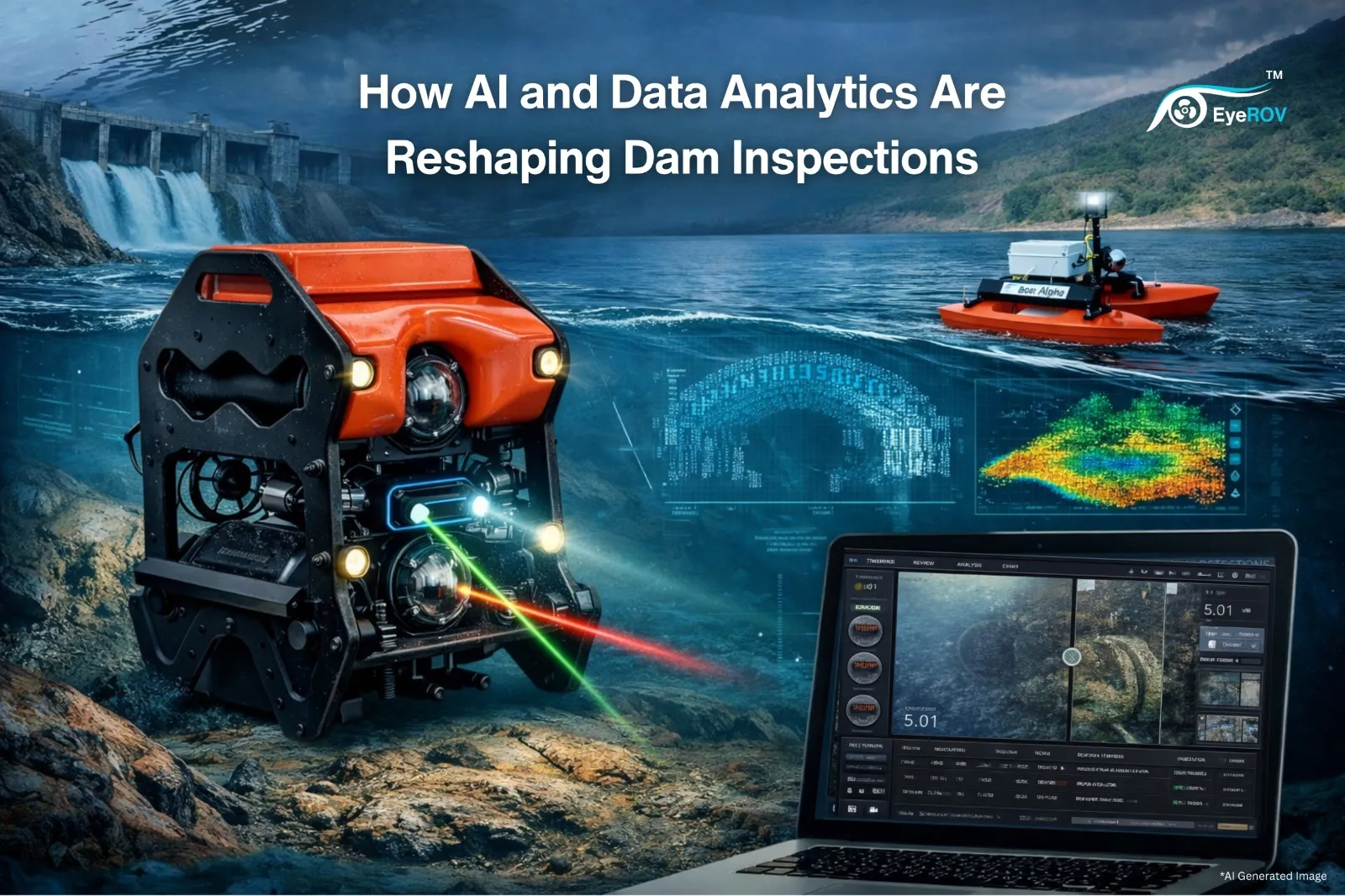
EyeROV’s inspection workflow reflects this shift. Platforms such as TUNA, Sagara, and TSROV (Tunnel Specialist ROV) are purpose-built for hydro infrastructure and equipped with multi-sensor payloads, including:
-
High-definition and 4K cameras
-
Imaging and multibeam SONAR
-
3D Mapping SONAR for tunnel geometry
-
Laser scalers for accurate crack and cavity measurement
-
Ultrasonic Thickness Measurement (UTM) for metal components
-
Doppler Velocity Logs (DVL) for navigation stability
This sensor fusion allows a single inspection mission to capture structural condition, geometry, and spatial context, creating data that can be compared across inspection cycles rather than archived as isolated observations.
iControlHub: AI at the Edge – Real-Time Defect Detection
Collecting underwater data is only half the challenge. The real breakthrough comes when AI is applied during the inspection itself, not weeks later during reporting.
EyeROV’s iControlHub acts as the operational brain of dam inspections, combining live sensor feeds with AI-powered real-time defect detection.
Real-Time Mission Intelligence
During inspections, iControlHub provides operators and engineers with:
-
Live HD video and SONAR feeds
-
Navigation, depth, and tether data
-
System health, stability, and mission status
This enables continuous situational awareness and ensures inspection coverage is complete while the ROV is still on site.
AI-Powered Real-Time Defect Detection
What fundamentally changes the workflow is real-time AI-based defect detection running during the inspection.
As the ROV surveys dam structures, iControlHub applies AI models to live video and SONAR streams to automatically detect, highlight, and tag defects in real time, including:
-
Cracks, spalling, and surface anomalies
-
Corrosion and coating degradation
-
Cavities, voids, and joint damage
-
Deformation indicators and misalignment in gates and embedded parts
-
High-risk zones requiring closer inspection or measurement
This allows engineers to identify issues immediately, adjust inspection focus on the spot, and ensure critical areas are captured with sufficient resolution, eliminating the risk of discovering major defects too late after the systems have left the site, making this exercise of close up survey and deeper investigations impossible or adding additional costs.
In practical terms, this shifts inspections from record first, analyze later to observe, detect, and validate simultaneously.
One Platform for Complex Dam Assets
Dam inspections typically involve multiple zones: upstream faces, gate grooves, stilling basins, tunnels, penstocks, and intake structures and many such components. iControlHub centralizes:
-
Video, SONAR, and sensor data
-
AI-detected defects with timestamps and location context
-
Mission logs, annotations, and event markers
Over time, this builds a single digital inspection history for each dam, replacing fragmented reports with a structured, queryable asset intelligence record.
EVAP: AI at Scale – From Detection to Engineering Insight
Once inspection data is captured, deeper analysis moves into EVAP (EyeROV Visualization and Analytics Platform).
While iControlHub focuses on real-time AI at the edge, EVAP applies AI and analytics at scale, enabling:
-
Advanced AI-based defect classification and validation
-
Image enhancement in turbid or low-visibility conditions
-
3D models and point clouds of tunnels, penstocks, and submerged structures
-
Defect severity ranking based on engineering criticality
EVAP transforms raw inspection data into engineering-grade outputs, supporting maintenance prioritization, budgeting, and long-term asset planning.
Understanding the Hydraulics and sedimentation Environment through advanced Bathymetry(I-Boat Alpha)
Dam safety and efficiency is affected by t hydraulic and sedimentation in the dam,which is often invisible from the surface and can be equally critical.
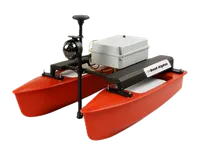
EyeROV addresses this through bathymetry surveys using I-Boat Alpha, an unmanned surface vessel (USV) designed for high-resolution mapping of reservoirs, stilling basins, and downstream plunge pools.
What I-Boat Alpha Delivers
I-Boat Alpha enables:
-
High-resolution bathymetric mapping
-
Sediment deposition and siltation profiling
-
Scour depth monitoring downstream of spillways
-
Repeatable surveys after floods and high-discharge events
-
Digital terrain models (DTMs) and volumetric analysis
Why Bathymetry Matters
Bathymetry data directly supports:
-
Reservoir capacity and siltation assessment
-
Intake safety through sediment buildup detection
-
Scour risk evaluation at stilling basins and aprons
-
Maintenance and dredging planning
-
Post-event assessment after extreme flows
Combined with ROV inspections, bathymetry closes the loop between structural condition and hydraulic behavior.
Data-Driven Applications Across the Dam Lifecycle
Upstream and Downstream Faces
ROV inspections map erosion, spalling, joint degradation, and exposed aggregates.
AI-detected defects are geotagged and measurable, enabling consistent comparison across inspection cycles.
Gates, Trash Racks, and Hydro-Mechanical Systems
AI-assisted inspections detect debris buildup, corrosion, and sediment accumulation, reducing the need for dewatering and preventing unplanned outages.
Stilling Basins and Aprons
SONAR and bathymetric data generate 3D models to assess scour depth, sediment migration, and post-flood structural changes.
Tunnels, Penstocks, and Pressure Shafts
The TSROV enables inspection of flooded tunnels up to 10 km and more, capturing geometry, siltation volumes, and lining damage, without shutdowns or drainage.
From Inspection to Prediction
When AI-detected defects and measurements are tracked across inspection cycles, the value shifts from reporting to prediction.
By monitoring defect growth rates, siltation trends, scour evolution, and material loss, dam operators can:
-
Prioritize repairs based on quantified risk
-
Forecast intervention timelines
-
Reduce emergency maintenance costs
-
Improve long-term capital planning
This is where AI delivers its strongest return, not by replacing engineers, but by giving them earlier warnings and defensible evidence.
Safety, Sustainability, and Scale
AI-driven ROV and USV inspections significantly reduce human exposure to hazardous environments, including:
-
Zero-visibility waters
-
Confined tunnels and shafts
-
High-flow and high-risk hydraulic zones
This aligns dam safety with modern ESG expectations, protecting both infrastructure and people.
Why This Matters Now
As dams continue to age and climate variability increases stress on spillways, gates, and foundations, inspections must evolve beyond checklists and snapshots.
The future of dam safety lies in:
-
Unmanned inspections
-
AI-powered real-time defect detection
-
Quantified condition assessment
-
Long-term digital asset intelligence
EyeROV’s integrated ecosystem, ROVs, iControlHub with real-time AI defect detection, EVAP analytics, and I-Boat Alpha bathymetry surveys, shows how this future is already being implemented across live hydro projects.
The Bottom Line
AI and data analytics are not replacing engineers.
They are giving engineers better evidence, earlier warnings, and clearer trends.
In dam inspections, that difference can mean:
-
Planned maintenance instead of emergency repairs
-
Measured risk instead of assumptions
-
Safety by design, not by chance
-
Confidence in infrastructure communities depend on every day
References:
UN University (2021) – Ageing Water Storage Infrastructure: An Emerging Global Risk
https://inweh.unu.edu/ageing-water-storage-infrastructure-an-emerging-global-risk/
NOAA Diving Manual (2017 Edition)
https://www.omao.noaa.gov/find/media-center/publications/noaa-diving-manual
ICOLD (International Commission on Large Dams) World Register of Dams
https://www.icold-cigb.org