







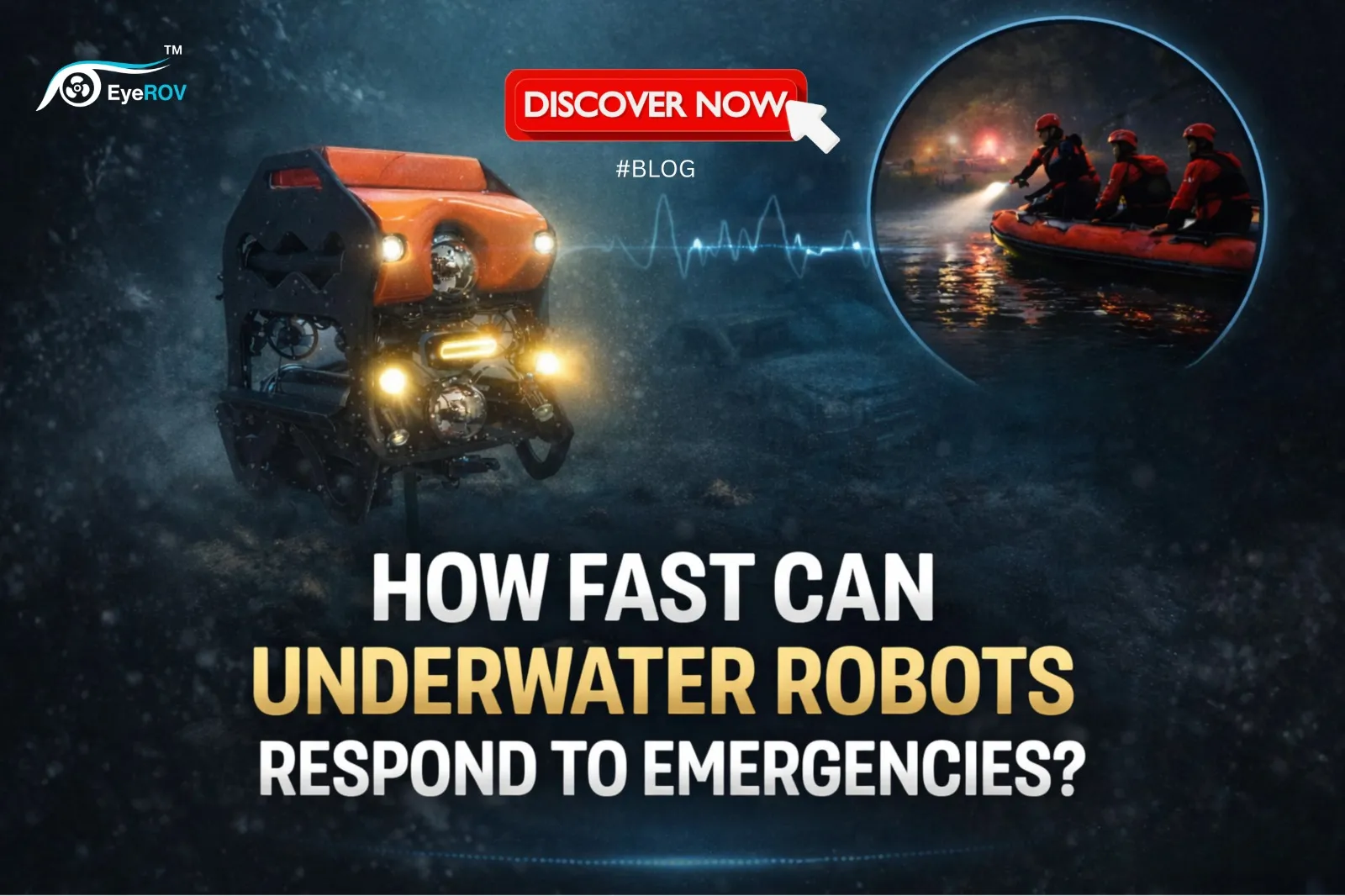
How Fast Can Underwater Robots Respond to Emergency Calls?
Underwater ROVs are transforming emergency response in low-visibility waters. Learn how robotic systems help rescue teams locate targets faster, reduce diver risk, and operate effectively in hazardous underwater environments.
When disaster strikes near water, time behaves differently.
Every year, rescue teams respond to landslides, flash floods, canal accidents, submerged vehicles, and industrial water incidents. In these moments, the greatest obstacle is not manpower.
It is visibility.
Mud, debris, oil, contamination, and unstable terrain can turn water bodies into opaque, hostile environments. Visibility drops to zero. Currents grow unpredictable. Obstacles hide beneath the surface. What should be a search operation quickly becomes a high-risk mission, not only for the missing, but for the rescuers themselves.
Traditionally, underwater searches depend on divers navigating by touch rather than sight. It is brave work. It is skilled work. But it is also dangerous.
Today, underwater Remotely Operated Vehicles (ROVs) are redefining emergency response, bringing speed, precision, and safety into environments where human vision fails.
Divers vs. ROVs: Strength Meets Technology
Both divers and ROVs play critical roles in underwater rescue missions. This is not a replacement story, it is an evolution story.
The Strength of Divers
Human divers bring:
-
Adaptability and rapid decision-making
-
The ability to physically sense and interpret objects
-
Immediate on-ground response in many communities
-
Emotional dedication driven by empathy and urgency
Their courage is undeniable.
However, underwater rescue environments often include landslide zones, high-current regions, drainage systems, debris fields, and contaminated waters. Divers face fatigue, limited bottom time, decompression risks, and in extreme cases, life-threatening hazards.
This is where technology steps in, not to replace human effort, but to protect it.
The Advantage of ROVs
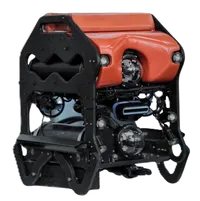
ROVs are engineered for environments that are unsafe for humans.
They offer:
-
Zero direct risk to human life
-
Stability in strong currents and confined spaces
-
Rapid deployment and structured search patterns
-
Continuous operation without fatigue
-
Reliable performance in turbid, zero-visibility water
-
Greater depth access within limited response windows
In high-risk situations, ROVs dramatically reduce exposure while accelerating results.
And in emergency response, speed is everything.
Proven in Real Missions
Speed is not just about how fast a system can enter the water, it is about how quickly it can deliver answers.
In one of our search operations, the water conditions were challenging, a scenario that would have required prolonged and dive efforts.
Our ROV was deployed and began a systematic sonar-based sweep of the area. Within a short time, the system detected a target anomaly. Using forward looking multibeam sonar for detection and high-resolution cameras for confirmation, the ROV successfully located the missing individual beneath the surface.
The operation supported authorities in completing their investigation and brought long-awaited closure to the family.
In another instance, during a live field demonstration, ship owners approached us with real concern. Their vessel had sunk, and they were uncertain whether it could even be found.
What began as a demonstration quickly turned into an actual mission.
We deployed the ROV and initiated a structured underwater search using forward looking multibeam sonar and precision navigation. Within the mapped grid, the system identified the submerged vessel resting below. Visual confirmation followed.
The missing boat was located.
That moment reinforced something important: underwater robotics is not just about technology, it is about delivering certainty in moments of doubt.
How ROVs Operate in Emergency Conditions
Water during emergencies is rarely calm. It is murky, violent, debris-filled, and unpredictable. Modern ROV systems are designed specifically for these realities.
1. High-Resolution Cameras with Adjustable Lighting
ROVs rely on high-resolution cameras for real-time inspection. But underwater lighting is never constant.
Our systems include:
-
Intensity-controlled lighting
-
Dimmable LED arrays
In slightly turbid water, reduced intensity prevents backscatter and glare. In deep or dark conditions, increased intensity enhances clarity. This adaptability ensures precise visual confirmation once a target is detected.
2. Forward Looking Multibeam Sonar for Zero Visibility
When cameras become ineffective, forward looking multibeam sonar takes over.
Sonar uses acoustic signals to create detailed representations of underwater structures and objects, even in completely opaque water.
The workflow is simple and efficient:
-
Sonar detects and outlines a potential object.
-
The ROV navigates toward the target.
-
Cameras provide confirmation.
-
If necessary, the robotic manipulator secures or interacts with the object.
This layered approach dramatically increases search speed.
3. DVL (Doppler Velocity Log) and Systematic Mapping
Precision matters in emergency response.
The DVL system provides:
-
Accurate movement tracking
-
Positional stability
-
Real-time area coverage data
This ensures structured grid-based searches instead of random exploration, saving critical time during operations.
4. Robotic Arm for Controlled Recovery
Once a target is identified and confirmed, the ROV can carefully approach and use its robotic arm to assist in retrieval or secure the object for recovery.
5. AI-Assisted Data Interpretation
Modern ROV systems integrate intelligent software that simplifies sonar interpretation, mapping analytics, and visual analysis.
Operators can read complex underwater data faster and make quicker decisions, improving response time when minutes matter.
Protecting Lives While Reducing Time and Cost
One of the most powerful benefits of ROV deployment is how it enhances diver safety.
Instead of sending divers into unknown, zero-visibility environments:
-
The ROV locates the target first.
-
Divers can follow the tether directly to the identified location.
-
Dive duration and exposure risk are significantly reduced.
This protects rescue divers, operational teams, and supporting contractors, while also shortening the emotional waiting period for families.
And as operational time decreases, costs decrease as well.
The ROV reduces both risk and expenditure, simultaneously.
So, How Fast Can Underwater Robots Respond?
They can be deployed within minutes.
They can scan systematically without fatigue.
They can detect what the human eye cannot see.
But more importantly, they can deliver answers faster, safer, and with greater precision.
Underwater emergencies demand courage. That will always belong to human responders.
But when visibility disappears and danger rises, underwater robots become a powerful ally.
When every second matters, underwater robotics is redefining not just how fast we respond, but how safely we do it.