




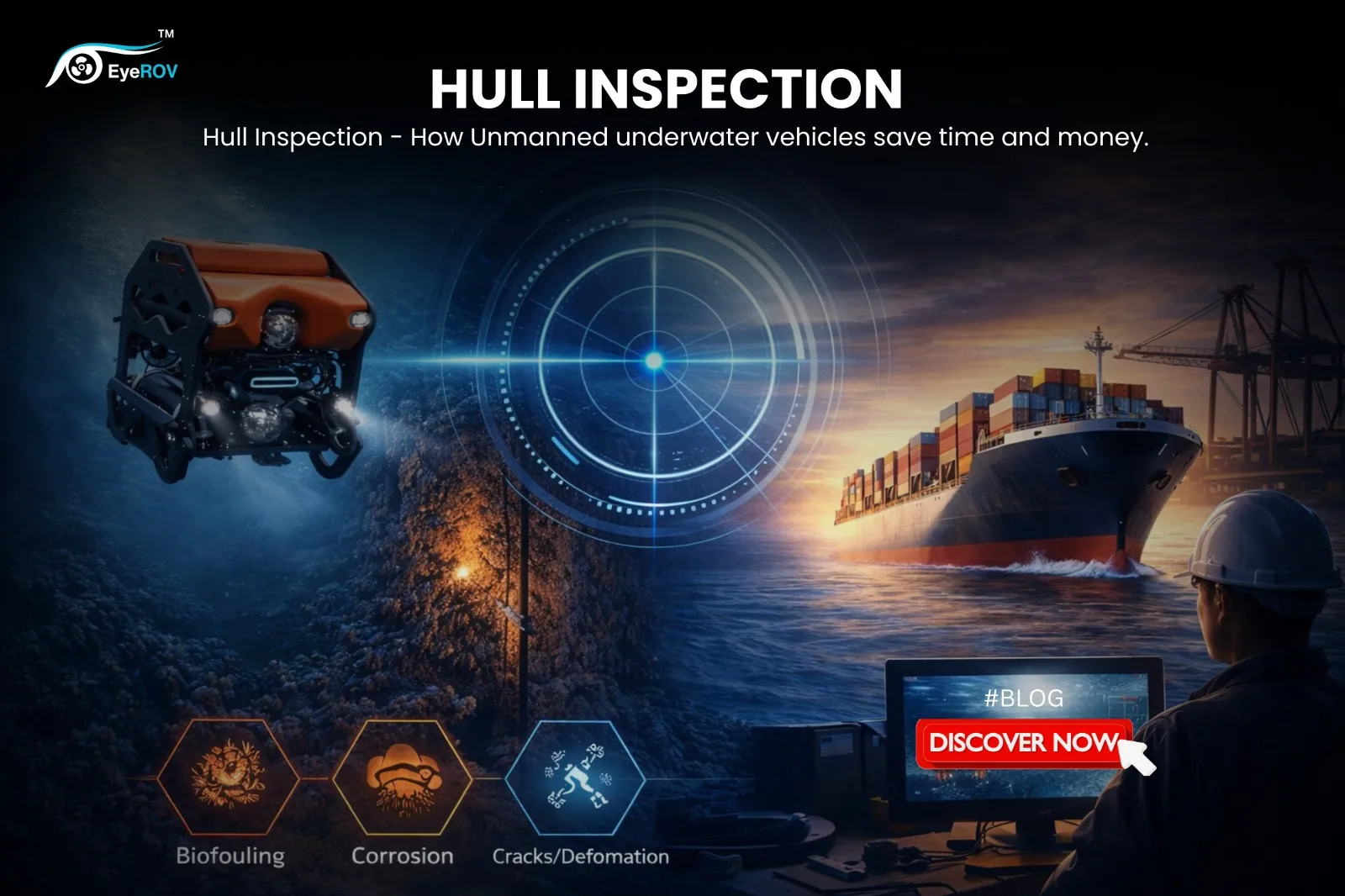
Hull Inspection - How Unmanned underwater vehicles save time and money.
Importance, methods, regulatory requirements, and the role of underwater ROVs in modern underwater inspection.
Why Hull Condition Matters
The ship’s hull is the structural and watertight envelope separating the vessel’s internal compartments from the marine environment. Its condition directly affects safety, fuel efficiency, and regulatory compliance. A deteriorating hull incurs higher operating costs, risks structural failure, and faces Port State Control (PSC) detentions.
What Degrades the Hull
Biofouling
Accumulation of barnacles, algae, and microorganisms on the submerged hull. Increases hydrodynamic drag and fuel consumption. Severe fouling can raise fuel burn by up to 40%. Also a vector for invasive aquatic species transfer between ports.
Corrosion
Electrochemical corrosion of steel plating driven by saltwater. Causes progressive plate thinning that reduces structural load capacity. Galvanic corrosion occurs at dissimilar-metal interfaces. Managed via sacrificial anodes and ICCP systems.
Cracks & Deformation
Fatigue cracking from cyclic wave loading, particularly at welds. Collision, grounding, and debris impact cause denting, buckling, and distortion.
Coating Deterioration
Anti-fouling and anti-corrosion coatings degrade through abrasion, cavitation erosion, and chemical breakdown. Failure exposes bare steel, accelerating corrosion.
Marine biofouling on ship hulls significantly increases hydrodynamic drag, resulting in higher fuel consumption and greenhouse gas emissions. Conventional methods of hull inspection and cleaning are often labour-intensive, time-consuming, and pose safety risks.
— Maritime & Port Authority of Singapore
Types of Hull Inspection
| Method | Description |
|---|---|
| General Visual Inspection (GVI) | Overall hull surface assessment from a standoff distance. Identifies significant biofouling, large-scale corrosion, visible coating failure, and gross structural deformation. Establishes baseline condition and flags areas for closer examination. |
| Close Visual Inspection (CVI) | Near-surface inspection to detect localised defects - micro-cracks, weld integrity issues, coating adhesion failures, and running gear condition. Requires enhanced lighting. Supports classification society survey requirements and defect documentation. |
| Dry Dock Survey | Mandatory five-year survey with vessel out of water. Most thorough method but vessel is off-hire for weeks, incurring significant operational and financial cost. Required by classification societies. |
| Underwater Inspection | Conducted at berth or anchorage without taking the vessel out of service. Performed by commercial divers or underwater ROVs between dry dock cycles. ROV-based inspection eliminates diver safety risks including entanglement, limited visibility, and marine organism exposure. |
Key Hull Zones and Inspection Criteria
| Zone | Key Inspection Items |
|---|---|
| Shell Plating | Marine growth (pre/post-clean); weld integrity; plate corrosion, buckling, deformation; sacrificial anode consumption (~75% target); bilge keel cracking |
| Fore End | Bulbous bow - indentation, bulging, cracking; chain marking impressions; bow thruster tunnel and grating; thickness gauging (vessels >5 years) |
| Aft End | Stern frame - cracks, erosion, bending, buckling; galvanic corrosion at dissimilar-metal junctions; ICCP system and anode condition |
| Rudder | Pressure test at 2.46 m water head; rudder drop, pintle clearance, jumping clearance; coupling bolt condition; position indicator alignment |
| Propeller & Stern Tube | Blade erosion, pitting, cavitation damage, bending; propeller drop; stern tube oil leakage; rope/net fouling; CPP blade movement and hydraulic integrity |
| Sea Chests & Openings | Sea chest plating and grating; MGPS function; overboard valve leakage; boiler blowdown valve; condition of previously repaired shell areas |
ROV Inspection vs Dry Docking
While dry dock surveys remain mandatory at five-year intervals under classification society rules, they involve significant operational disruption and cost. Dry docking requires the vessel to be taken completely out of service, often for several weeks, during which the ship is off-hire and generating no revenue. Beyond direct docking fees, shipowners incur additional costs including loss of charter income, port and yard scheduling delays, mobilisation and demobilisation expenses, and extended idle time awaiting dry dock availability. In many cases, dry dock slots are not immediately available when inspection is urgently required, creating operational bottlenecks. ROV-based underwater inspection eliminates the need to dry dock the vessel between mandatory survey cycles. Inspections can be conducted at berth or anchorage without interrupting cargo operations, with no requirement to remove the vessel from water.
| Dry Dock Survey | ROV Underwater Inspection |
|---|---|
| 10 - 14 off-hire period | 2 - 6 off-hire period |
| Significant docking and yard fees | Lower overall inspection cost |
| High manpower mobilisation | Reduced manpower requirements |
| Dry dock slot availability dependent | Conducted fully underwater, no waiting period required |
| Revenue loss during idle period | Cargo operations uninterrupted |
| Diver safety risks for underwater elements | Minimised human intervention with high-accuracy digital data capture |
For commercial vessels, every operational day directly impacts revenue. ROV inspection transforms hull assessment from a prolonged, high-cost event into a streamlined operational activity, enabling proactive maintenance decisions between mandatory dry dock cycles. By integrating ROV inspections into maintenance planning, shipowners can optimise scheduling, reduce lifecycle costs, and maintain regulatory compliance without unnecessary operational interruption.
Underwater ROV Inspection and Systems
ROV-based underwater hull inspection eliminates diver safety hazards, can be conducted without interrupting cargo operations, and produces recorded video and image datasets suitable for reporting to classification societies and Port State Control (PSC) authorities.
In turbid port water with high suspended sediment concentration, standard camera systems lose effective range. Specialised turbid-water optical modules extend camera range and maintain inspection-grade image quality. Hull plate thickness is measured using ultrasonic testing (UT) probes operated alongside the ROV. Post-inspection, footage is processed through AI-based image enhancement and colour correction to enable accurate defect assessment, with findings classified per IMO biofouling rating categories.
| System | Specification | Application |
|---|---|---|
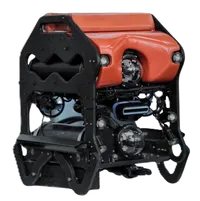
| EyeROV TUNA | 4 DoF · HD/4K camera with tilt · 300 m depth-rated | GVI of shell plating, sea chests, bulbous bow, bow thruster region |
| EyeROV TROUT | 6 DoF · Dual HD/4K cameras · 10x optical zoom · 300 m | CVI of propellers, rudder surfaces, bilge keels, restricted-access areas |
| EVAP | AI analytics platform · 3D reconstruction · Fouling classification · Report generation | Post-inspection image processing, IMO biofouling classification, regulatory report generation |
UnderWater Hull Inspection: Bulbous Bow and Bow Thruster Region
The following summarises a hull inspection deployment by EyeROV on a commercial vessel at berth, covering the bulbous bow and bow thruster region.
Inspection Objective
- Full underwater inspection and videography of bulbous bow and bow thruster region
- Document structural damage, coating deterioration, and running gear defects (GVI + CVI)
Systems Deployed
- EyeROV TUNA with Specialised Turbid Water Module
- Surface control station, generator, tether management system
- EVAP for post-mission image enhancement and report generation
Technical Conditions
- Severely reduced visibility due to suspended sediment - turbid water module required
- Bow thruster tunnel presents diver entanglement risk - ROV deployment eliminated this hazard
Results Delivered
- Raw footage processed through EVAP - AI colour correction recovered inspection-grade imagery
- Structural condition, coating integrity, and running gear status fully documented
- Reports delivered in hard copy and digital format; no diver deployment required
How ROV-Based Inspection Works
The ROV is equipped with Full HD or 4K zoom cameras, controllable LED lights, and sonar to ensure clear imaging even in low-visibility waters. The inspection begins with a general visual survey to assess the overall hull condition and identify marine growth or visible damage. The hull is then cleaned using a non-damaging cavitation system, followed by a close inspection and Ultrasonic Testing (UT) to measure steel thickness and detect corrosion. All inspection data, including enhanced visuals and thickness measurements, is compiled and shared with the client through EVAP for clear evaluation and decision-making.