






Penstock Inspection Using ROV: No Draining, No Downtime
Draining a penstock costs a plant real revenue. See how ROV-based inspection measures wall thickness while the pipe stays fully flooded.
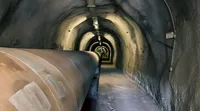
Most of us rarely think about what happens between a reservoir and the electricity that reaches our homes and workplaces. One of the key parts in that journey is the penstock, a large steel pipe that carries water from the reservoir or diversion system to the turbines of a hydropower plant.
In many hydropower projects, water first travels through long headrace tunnels before entering the penstock. The penstock carries that water under pressure to the powerhouse. Beyond power generation, it also plays a critical role in safely moving large volumes of water from intake to powerhouse.
Because the water inside the penstock flows under high pressure, the steel wall of the penstock is continuously subjected to significant load. Over time, corrosion or wear can reduce its thickness and affect penstock structural integrity and safe operating capacity.
That is why penstock inspection matters. The real question is not whether the inside of the pipe looks fine, but whether the steel wall is still thick and strong enough to safely carry pressurised water.
Traditionally, answering that question has meant draining the penstock and sending an inspection crew inside. An ROV offers a different path: it can inspect the pipe while it stays flooded, capture detailed visuals, and measure wall thickness.
Why penstock inspection matters
Year after year, the wall corrodes, thins, or cracks, and none of it shows from the outside. Regulators require internal inspection on a set schedule, and the whole exercise comes down to one question: is the wall still sound.
Why traditional penstock inspection is hard to schedule often
The real cost of dewatering is not the inspection itself. It is the generating unit sitting offline for however long the job takes, and every day of that is lost revenue.
The alternative is a manual entry once the pipe is drained. That still means covering a long, dark steel tube, sometimes hundreds of metres of it, reached through gate openings that are often high on the dam. Coverage per entry is limited, and the pipe usually has to be revisited more than once to inspect the full length.
Either way, the same gap remains. A visual inspection, however careful, cannot confirm how thick the wall actually is. Looking fine and being fine are not the same thing.
How an ROV changes the inspection process
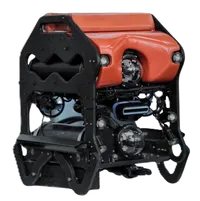
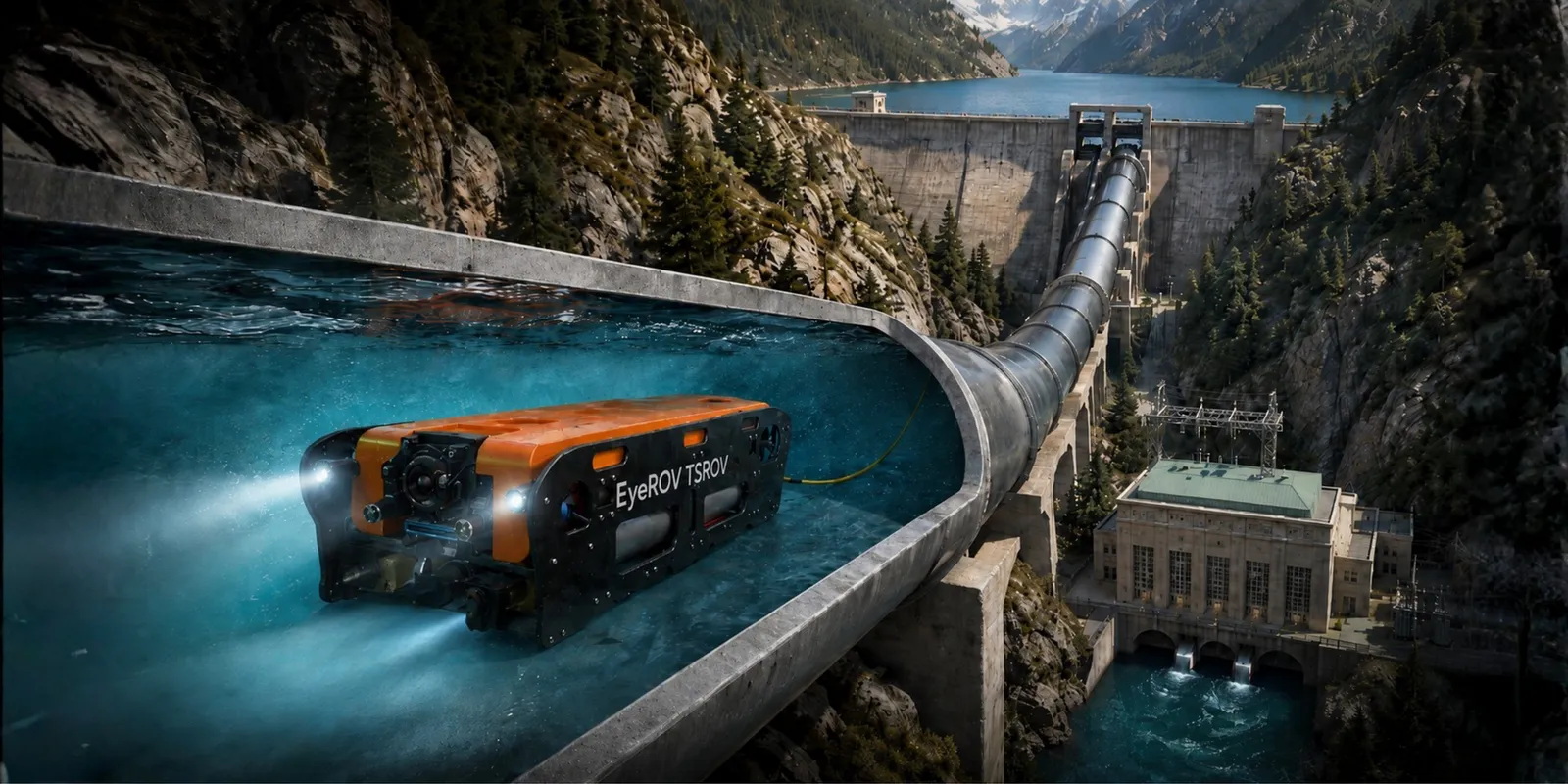
An ROV goes into the penstock while it is still full, and while the unit stays online. The plant does not lose a single day of generation to the inspection itself. At EyeROV, a confined-space platform such as TSROV is used for this kind of work, deployed from the dam top at the intake gate and driven the full length of the pipe under its own power, all the way to the main inlet valve.
That is the difference between covering the whole bore in one continuous run and relying on several partial entries, the way a manual inspection usually has to.
Beyond visual inspection: measuring wall thickness
A camera can only show a picture, so the vehicle carries more than a camera as part of its sensor payload. 3D mapping sonar scans the shape of the pipe as it moves, building a continuous picture of the internal diameter and flagging any deformation. An ultrasonic thickness probe does the part a camera cannot: it checks the actual steel thickness at four points around the pipe, the 12, 3, 6, and 9 o’clock positions, at set intervals along the length, and checks each reading against the original design drawings. A high-definition camera fills in the rest: coating condition, surface wear, anything visible.
All three streams live to a control station on the surface, so the data arrives as the inspection happens, rather than after the vehicle is recovered.
Put together, that is the real shift. A picture shows what the pipe looks like. A measurement shows whether it is still safe, and that is the difference between a survey and an assessment. Run the same inspection on a schedule and each reading ties back to a specific position on the pipe, so this year’s number can be checked directly against last year’s at the same spot. That turns the question from whether there is a problem right now into how the pipe is changing, which is a far better basis for planning repairs before they become urgent.
What to ask before hiring an inspection team
- Does the vehicle carry more than a camera? Ask specifically about sonar and ultrasonic wall-thickness measurement.
- Can it travel the full length of a long, confined pipe under its own power, without the pipe being drained?
- Is the inspection viewable live, or only after the fact?
- Is the data tied to a specific position on the pipe, so a future inspection can be compared directly against this one?
- What is delivered at the end: a report that can be acted on, or just footage that still needs interpreting?
Frequently Asked Questions
Does penstock inspection require dewatering?
No. An ROV travels the full length of the penstock while the pipe stays full, so the unit does not need to be taken offline for the inspection itself. See EyeROV’s dam inspection services for how this fits into a wider inspection programme.
What does an ROV actually measure inside a penstock?
Internal shape, using 3D mapping sonar, wall thickness at defined points, using an ultrasonic probe, and surface and coating condition, using a high-definition camera. For background on how these vehicles work, see what is ROV.
Why isn’t a visual inspection enough on its own?
It can show how the surface looks, but it cannot confirm how thick the steel wall still is, and that is the number that actually determines whether the structure is safe.
What do inspectors check for inside a penstock?
The shell, supports, joints, embedded sections, and appurtenances, for corrosion, cracking, misalignment, and other material defects.
What happens to the inspection data afterward?
It is position-tagged and processed into a report, typically a hard copy alongside a digital version, giving a record that can be compared against future inspections rather than a one-off snapshot. Reports can be managed through EVAP, EyeROV’s data visualisation and analytics platform.
Plan your next penstock inspection with EyeROV
A missed defect in a penstock is expensive, and so is the conventional way of finding one, which is part of why many penstocks go longer between inspections than they should. ROV-based inspection removes that trade-off: full coverage, real measurements, no dewatering, and no lost generation days. For the full technical detail behind this approach, read EyeROV’s whitepaper, ROV-Based Inspection of Hydropower Penstocks.
To talk through a penstock inspection programme, contact EyeROV or write to info@eyerov.com.