



Rig Mooring Systems Failure Prevention: A Practical Guide
A practical guide to rig mooring systems failure prevention, covering causes of failure, inspection, tension monitoring and how ROVs support subsea mooring inspection.
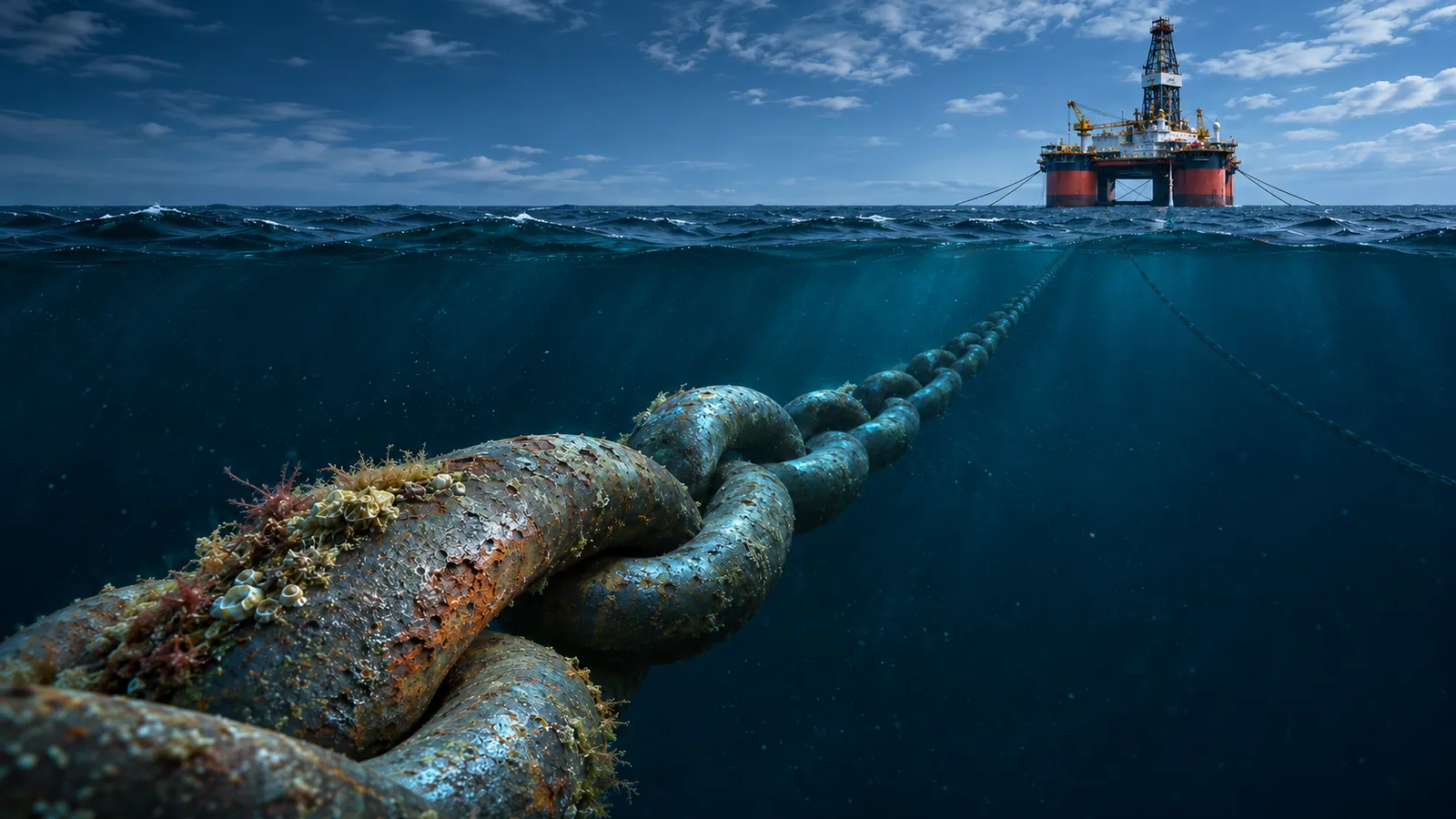
Floating drilling rigs and production units can spend years over the same patch of seabed. What keeps them there is the mooring system: lines of steel chain, wire rope or polyester rope, joined by connectors and fixed to anchors in the seabed.
When one part of that system fails, the remaining lines take the extra load. If more lines go, the rig can drift off station, putting risers, wellheads and production at risk.
These failures usually build up slowly and out of sight, so rig mooring systems failure prevention depends on finding damage early and acting before it reaches a full line failure.
What causes rig mooring system failures?
In most cases, a mooring line fails when long-term damage meets a load the weakened component can no longer carry.
Corrosion, fatigue and material degradation
Seawater is rich in dissolved salts and oxygen, and both react steadily with steel chain and wire. Over time this causes general metal loss and deeper pitting, which thin each link and reduce its strength. The splash zone and the touchdown point, where chain lifts off and settles on the seabed, are often the worst-affected areas.
Marine growth adds weight and drag, and it hides damage from view. Wave-driven motion loads every component millions of times, and small fatigue cracks can grow until a link breaks. In the stud-link chain, cracks often start at the stud weld. Near the fairlead, high tension can lock the top links together so they bend sideways, a failure mode known as out-of-plane bending.
Excessive loads and environmental forces
Waves, wind and current move a floating rig constantly, and severe storms or strong currents can push line tensions far above normal levels. If one line has already lost strength, its neighbours carry more load, and failures can follow one after another.
Installation errors and component defects
Some failures begin before the rig is even on station. Chain can be twisted or damaged during handling, connectors can be assembled wrongly and synthetic ropes can be cut by seabed contact. Poor heat treatment or weld defects during manufacture leave weak points that fail early.
| Failure cause | Where it shows up | Early warning signs |
|---|---|---|
| Corrosion and pitting | Splash zone, touchdown point | Reduced link diameter, pits, heavy scale |
| Fatigue cracking | Links and connectors near the fairlead | Surface cracks, repeat failures in similar lines |
| Wear and abrasion | Fairleads, seabed contact zone | Flattened or worn link contact points |
| Excessive storm loads | Weakest component in the line | Tension spikes, larger vessel offsets |
| Anchor drag | Anchor and seabed area | Slow tension loss, position drift |
| Installation or manufacturing defects | Any component | Twists, gouges, cracks at welds |
How can operators prevent rig mooring system failures?
Prevention runs from design to retirement, usually under a mooring integrity management plan.
Verify design, component quality and installation
Mooring designs are checked for both intact and damaged conditions, so the rig can hold station even if one line fails. Offshore chains come in high-strength grades, each with set minimums for strength, stretch and toughness, and the grade should match the expected loads. Mobile drilling rigs often use stud-link chains, which are less prone to tangling during repeated deployment, while permanent moorings tend to use lighter studless chains with longer fatigue life. Every link is proof-load tested and its welds checked at the mill, and operators should confirm these records before deployment. During installation, crews check for twists and handling damage, pretension each line to confirm anchor holding capacity and record the as-installed condition as a baseline.
Manage environmental conditions and mooring loads
Weather forecasts should be compared against design limits so line adjustments happen before a storm, not during it. A moored rig cannot simply move away when bad weather is forecast, so the system has to ride out uncertain conditions and rough, turbulent seas. Shifting line payout from time to time moves the contact points at fairleads and spreads wear along the chain.
Establish preventive maintenance procedures
A good maintenance plan covers fairlead lubrication, marine growth cleaning and replacement of worn sections. Spare chain, connectors and an approved repair procedure should be ready in advance to avoid long delays after a failure.
How should mooring systems be inspected and maintained?
Routine inspections and condition assessment
A condition assessment usually combines general and close visual inspection with link diameter measurement, which tracks metal loss against the design corrosion allowance. Inspectors also look for cracks, locked or bent links near the fairlead and loose connector parts. Damage buried below the mudline will not show up in visual checks and needs separate planning.
Inspection scheduling and defect management
Inspection intervals should follow risk, with shorter gaps for older systems, harsh locations and lines with known defects. Each defect should be logged with its location, size, photos and severity, then assigned an action, an owner and a deadline.
How does mooring tension monitoring help prevent failures?
If inspections are periodic health checks, tension monitoring is the continuous pulse reading. Load cells at the fairlead or winch, line angle sensors and GNSS position data show how each line is loaded in real time.
Detect abnormal loads and position changes
A sudden drop in tension on one line, together with a change in vessel offset, often signals a broken line or a dragging anchor.
Set alerts and escalation procedures
Operators should set alarm limits for tension and offset, and link each level to a clear response, from checking sensors to calling for a subsea inspection, with a named person responsible.
How can ROVs support subsea mooring inspection?
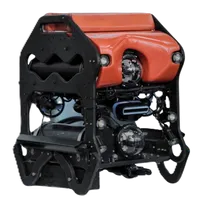
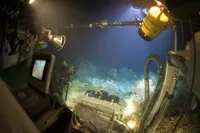
An ROV, or remotely operated vehicle, is an underwater robot piloted from the surface through a tether that carries power, video and control signals. For mooring work, it brings subsea components into view without recovering the lines.
Inspect Subsea Chains, Connectors, and Anchor Areas
An inspection-class ROV can follow a mooring line from the fairlead to the touchdown point, recording HD video of corrosion, wear, cracks and damaged connectors along the way. Depending on the task, it can carry payloads such as a laser scaler to measure link diameter and imaging sonar for low-visibility water. ROVs can also deploy pulsed eddy current (PEC) sensors, which estimate corrosion and metal loss in steel without removing coatings or marine growth. Around the anchors, the ROV can survey the seabed for signs of drag or scour.
Improve inspection evidence and maintenance planning
Every dive produces dated, location-tagged footage and measurements that engineers can compare directly with earlier surveys. Post-processing tools such as visualising platforms turn that footage into structured reports, with location data, clear images and measurements of cracks and other defects. This gives integrity teams clear evidence for repair decisions.
What should a rig mooring failure prevention checklist include?
- Design verified for intact and damaged conditions
- Certificates and proof-load records for all components
- As-installed baseline survey and pretension records
- Fatigue and corrosion assessment of high-risk zones
- Risk-based inspection schedule, with post-storm checks
- Link diameter and corrosion trend records for each line
- Tension and offset monitoring with alarm limits
- Escalation procedure with named owners
- Defect log with actions and deadlines
- Spares and an approved repair procedure
Protect your offshore operations before failure strikes
Mooring failures rarely arrive without warning.
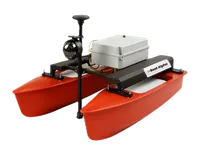
Clear evidence from below the waterline lets operators and infrastructure owners plan repairs on their own schedule rather than after a failure. EyeROV builds ROVs such as SAGARA for underwater inspection of offshore and marine infrastructure, with optional payloads and post-processing through EVAP. Explore EyeROV’s underwater inspection solutions and strengthen your rig mooring system failure prevention strategy with greater confidence.
Frequently asked questions
Can ROVs inspect subsea mooring components?
Yes. ROVs can follow a mooring line from the fairlead to the seabed, recording video of chains, connectors and anchor areas. They can also measure link diameter with a laser scaler payload.
Can a rig continue operating if one mooring line is damaged?
It depends on the design and conditions. Mooring systems are usually designed to hold stations with one line broken, but with lower safety margins. Operators usually restrict operations and plan an early repair.
What is the difference between spread mooring and turret mooring?
Spread mooring holds a vessel at a fixed heading using lines at several points around it. Turret mooring connects all lines to a turret, letting the vessel rotate to face the weather.
How do operators assess the remaining service life of a mooring system?
They compare measured link diameters and defects against the design corrosion allowance and minimum breaking load, then run fatigue analysis using recorded tension data and inspection history.
What is the role of anchor holding capacity in mooring system reliability?
The anchor must hold the full line load without dragging. If holding capacity is too low for the seabed soil, the anchor can move in a storm, shifting load onto other lines and pulling the rig off position. Pretension testing during installation confirms capacity.