




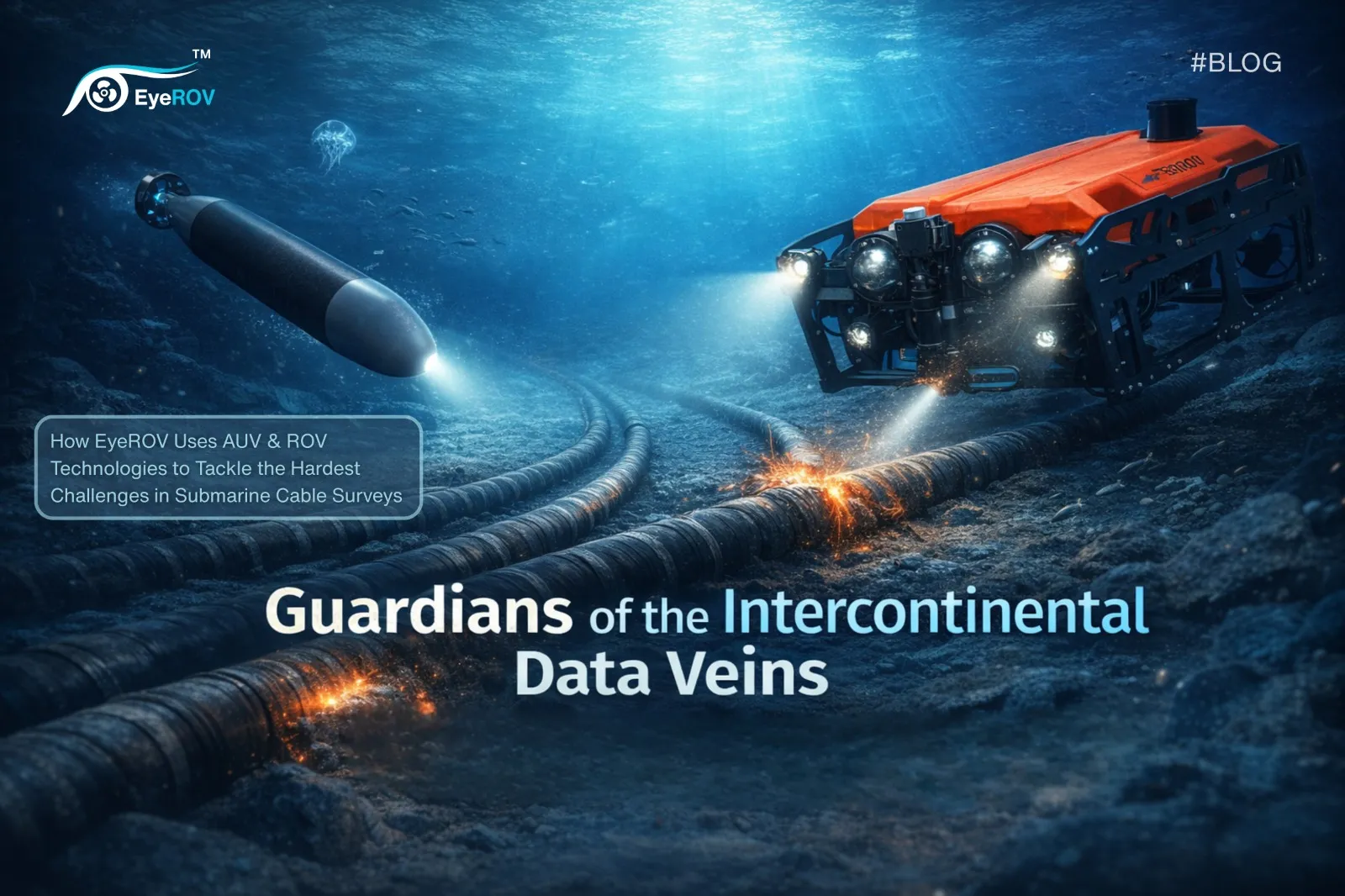
Guardians of the Intercontinental Data Veins
How EyeROV Uses AUV & ROV Technologies to Tackle the Hardest Challenges in Submarine Cable Surveys.
How EyeROV Uses AUV & ROV Technologies to Tackle the Hardest Challenges in Submarine Cable Surveys
Every second, millions of financial transactions clear. Video calls span continents. Cloud servers synchronize across oceans.
Almost all of it, quietly and invisibly, travels through submarine fiber-optic cables resting on the seabed.
At EyeROV, we operate where this invisible digital world meets physical reality.
Over years of subsea operations, one lesson has become clear:
Submarine cable inspection is not about vehicles or sensors.
It is about reducing uncertainty in one of the harshest environments on Earth.
This is the story of how EyeROV applies underwater robotics to solve that challenge.
The problem no one sees, until it fails
Nearly 99% of international data traffic flows through submarine cables. Yet these intercontinental data veins lie:
- Out of sight
- Often buried or partially exposed
- Exposed to shifting seabeds, fishing activity, anchors, and geohazards
When a cable fails, operators ask a deceptively simple question:
What actually happened down there?
At EyeROV, every subsea asset inspection mission begins with that question.
Challenge 1: Scale vs. certainty , seeing enough, and seeing clearly
A single cable route can extend hundreds or thousands of kilometers. Conducting continuous visual ROV inspection services along the entire route is neither practical nor economical.
Yet relying solely on wide-area data risks missing critical details.
The challenge is clear:
How do you see everything that matters, without inspecting everything the same way?
The EyeROV approach
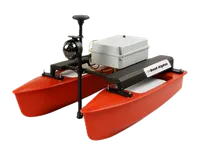
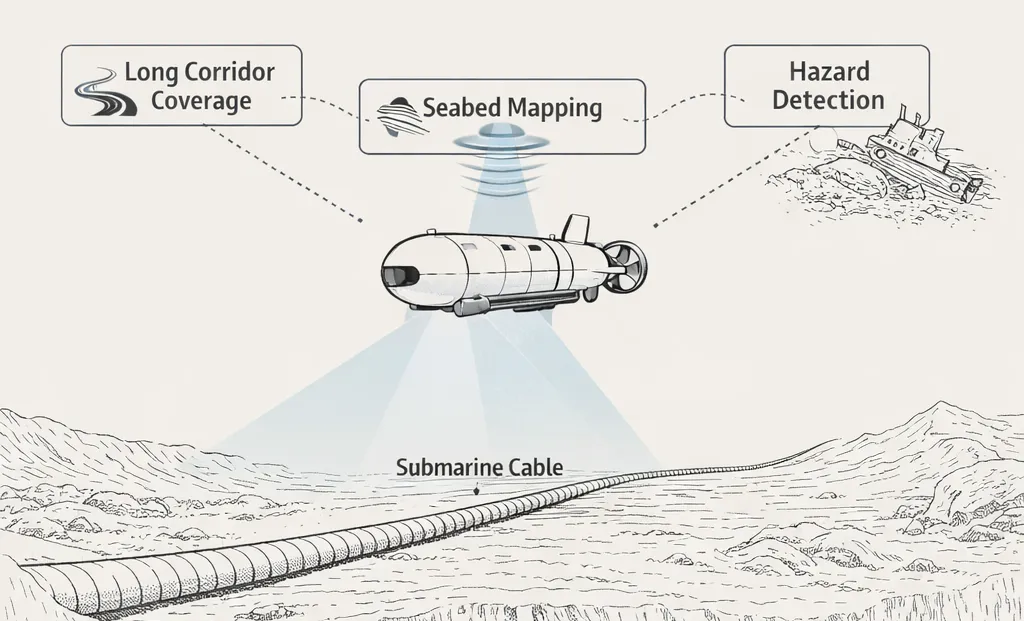
We deploy Autonomous Underwater Vehicles (AUVs) as the first layer of intelligence within our underwater survey robotics framework.
AUVs allow us to:
- Cover long cable corridors efficiently
- Collect consistent multibeam bathymetry and side-scan sonar data
- Build a detailed understanding of seabed morphology and potential hazards
Rather than guessing where issues might exist, EyeROV uses AUV-based subsea inspection data to systematically reduce uncertainty at scale.
Challenge 2: The paradox , cables are critical, but hard to detect
One of the least intuitive realities of submarine cable work is this:
The cable itself is often the hardest thing to see.
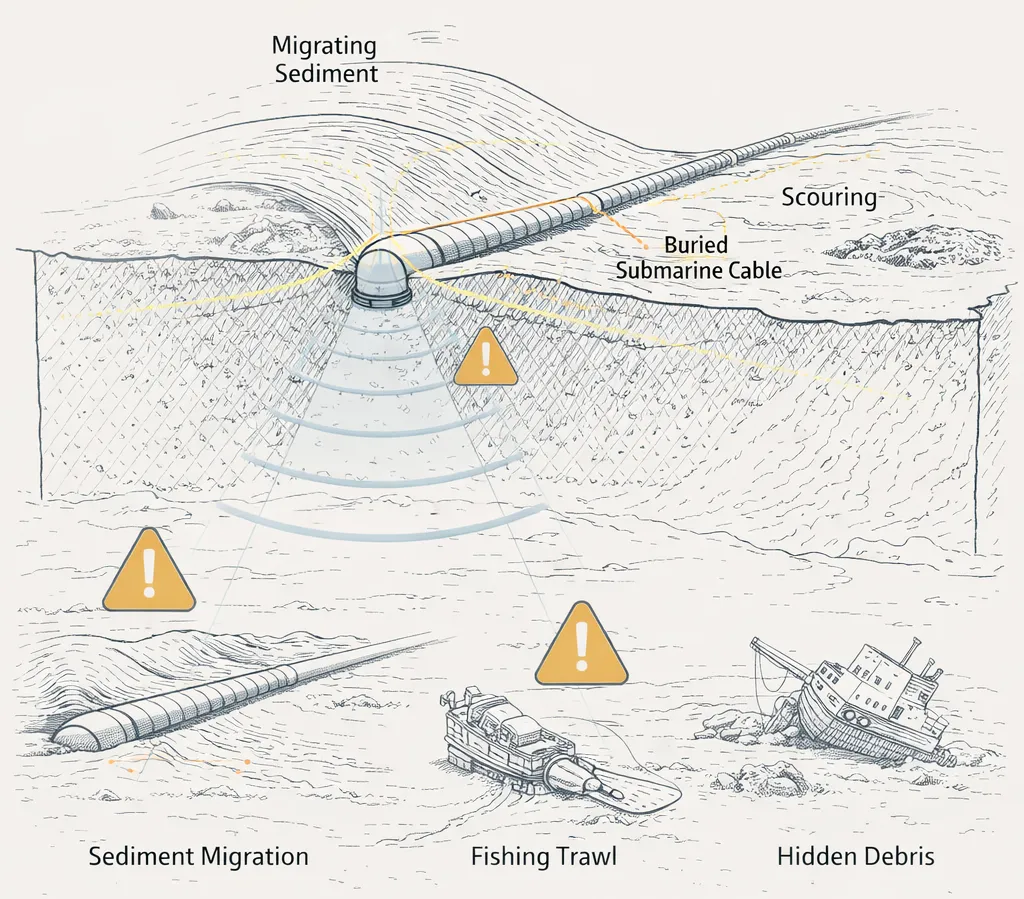
Modern fiber-optic cables are thin, frequently buried, and easily camouflaged by sediment. Even advanced sonar may struggle to detect them directly in complex seabed conditions.
At EyeROV, we don’t rely on a single sensor, or a single assumption.
Our mindset
Instead of asking “Can we see the cable?”, we ask:
“What could threaten the cable here, and how confident are we?”
Using AUV-based underwater drone inspection, we focus on detecting:
- Seabed instability
- Scour and erosion features
- Debris fields
- Slopes and geological transitions
These factors often represent the true indicators of future cable risk, even when the cable itself is not visible.
Challenge 3: Too much data, too little clarity
Large-scale inspections generate enormous volumes of data.
The real challenge today is no longer collection—it is decision clarity.
Cable owners don’t need more sonar images.
They need answers:
- Which anomalies matter?
- Which can wait?
- Which require immediate intervention?
This is where many subsea programs slow down.
The EyeROV solution
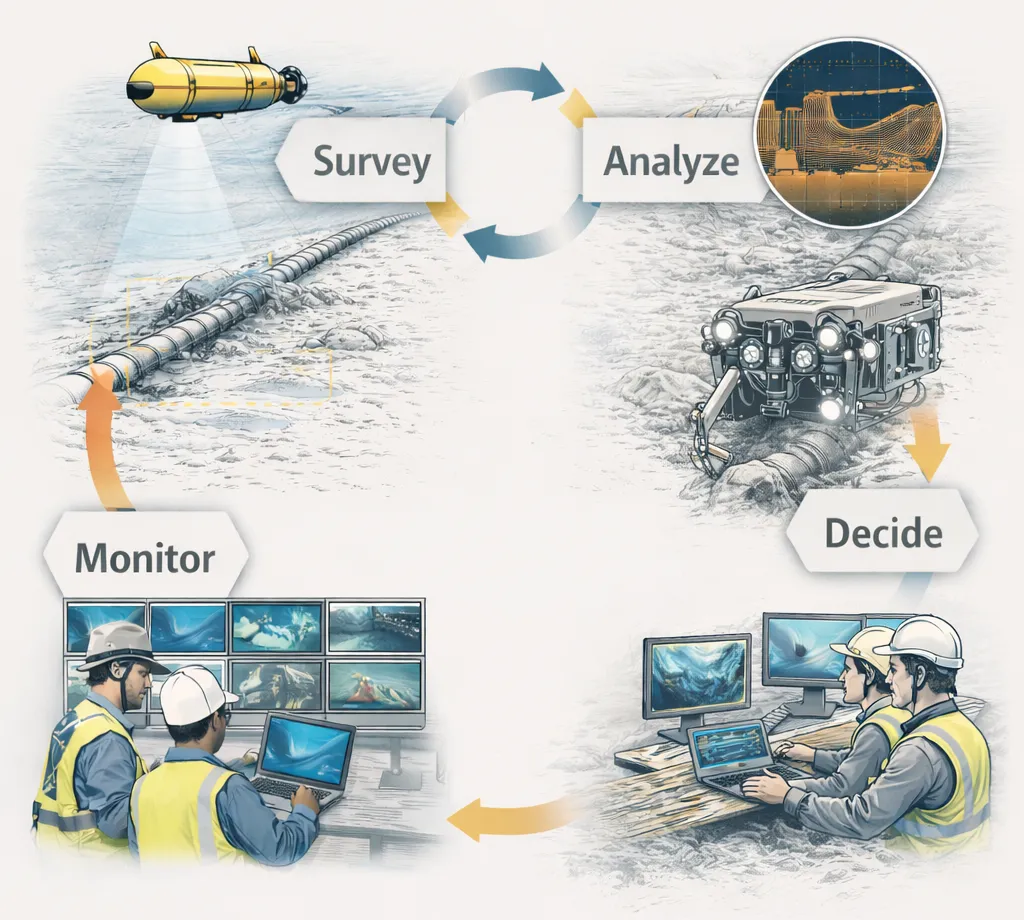
We combine engineering judgment, data analysis, and operational experience to convert raw outputs into:
- Ranked anomaly lists
- Risk-based inspection priorities
- Clear, actionable next steps
At EyeROV, data is never the end product.
Decisions are.
Challenge 4: When certainty is required, nothing replaces eyes on target
There comes a point in every submarine cable inspection where sonar is no longer sufficient.
When exposure, interaction, or damage is suspected, the question becomes binary:
Is this real or not?
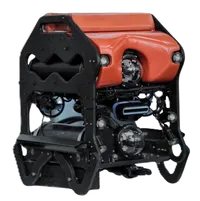
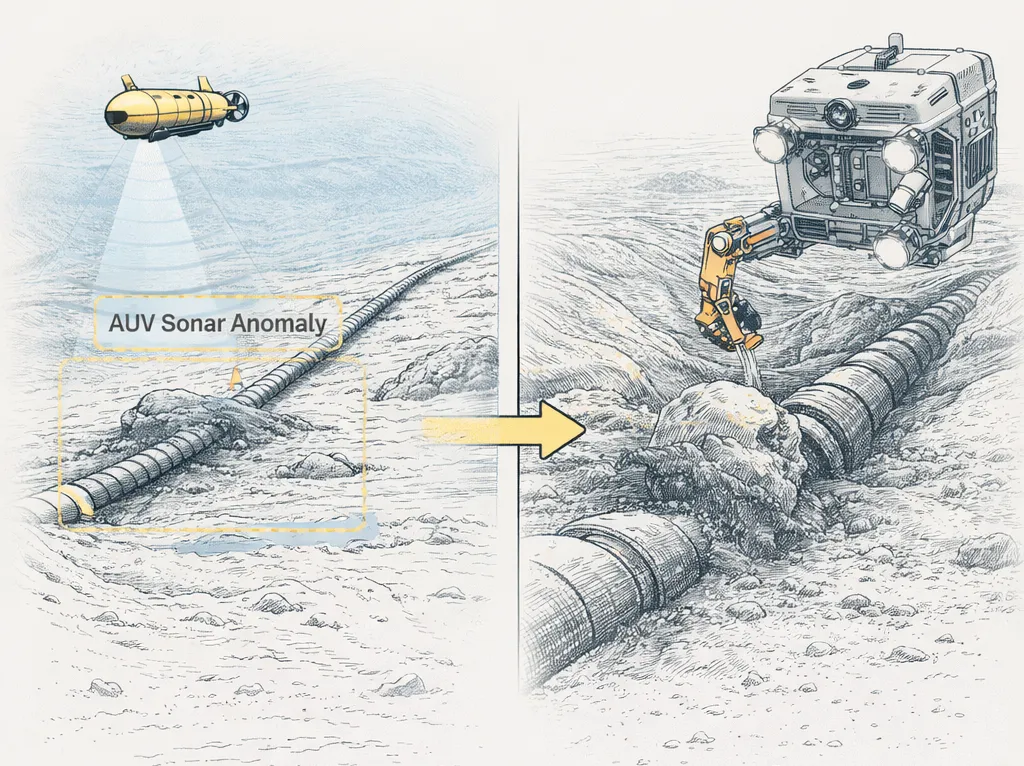
This is where Remotely Operated Vehicles (ROVs) become essential.
How EyeROV uses ROVs
We deploy ROVs only where they deliver maximum value:
- Visual confirmation of exposure or damage
- Measurement of free spans and clearances
- Identification of fishing gear, anchors, or debris
- Support for repair and protection planning
By letting AUVs narrow the field, EyeROV ensures that every ROV inspection service dive is targeted, efficient, and decisive.
Challenge 5: Time, cost, and the reality of offshore operations
Vessel time is expensive. Weather windows are short. Cable owners often need answers fast, especially after storms, seismic events, or third-party interference.
Traditional, ROV-only inspection models struggle to scale under these constraints.
EyeROV’s hybrid inspection model
By combining:
- AUVs for coverage and consistency
ROVs for confirmation and precision
…EyeROV significantly reduces:
- Total vessel days
- Overall operational cost
- Time from inspection to decision
This hybrid approach enables more frequent monitoring, directly improving long-term cable resilience.
The bigger picture: from surveys to resilience
For EyeROV, submarine cable inspection is not a standalone task.
It is part of a long-term resilience strategy.
By delivering:
- High-quality baseline datasets
- Repeatable inspection methodologies
- Clear links between data and operational decisions
…we help cable owners move from reactive inspection to proactive risk management.
Why this matters
Submarine cables will only grow more critical.
The oceans will not become calmer.
The seabed will not become simpler.
What must improve is how we see, interpret, and respond.
As a marine robotics company, EyeROV doesn’t just deploy AUVs and ROVs.
We deploy them with intent, each tool solving a specific challenge in the ongoing story of subsea infrastructure protection.
Sources & references
- International Telecommunication Union (ITU) – Submarine cable resilience
https://www.itu.int/en/mediacentre/backgrounders/Pages/submarine-cable-resilience.aspx - SubOptic / TeleGeography – Global submarine cable systems
https://www.suboptic.org/news/how-many-submarine-cables-are-there-anyway - TeleGeography – State of the Network 2024
https://www2.telegeography.com/hubfs/LP-Assets/Ebooks/state-of-the-network-2024.pdf - ScienceDirect – AUV cable tracking challenges
https://www.sciencedirect.com/science/article/pii/S0029801823010739 - University of Southampton ePrints – Cable detectability limitations
https://www.eprints.soton.ac.uk/493608/