








Subsea PEC Wall Thickness Inspection: 7 Essential Insights
Subsea PEC wall thickness inspection uses a magnetic pulse to detect corrosion under coatings. Learn how pulsed eddy current screening works, where it applies, and how it compares to UT.
Offshore assets sit in one of the most aggressive environments for metal infrastructure. Dissolved salts accelerate corrosion, and currents, pressure, temperature swings and marine growth all make inspection harder. Pipelines, FPSOs, ship hulls and platform structures are commonly protected with coatings or cathodic protection, but these systems reduce corrosion risk without eliminating it.
Coatings deteriorate, cathodic protection loses effectiveness over time, and corrosion can develop beneath coatings, insulation or marine growth without any visible sign. Conventional inspection often needs coating removal or direct access to bare steel. Subsea Pulsed Eddy Current (PEC) wall thickness inspection offers an alternative: screening ferromagnetic components through suitable layers, without stripping them first.
1. What is subsea PEC wall thickness inspection?
Subsea PEC is a non-destructive testing method used mainly to identify corrosion-related wall loss in ferromagnetic assets underwater, including vessels, rig legs, conductor pipes, subsea pipelines and ship hulls.
Unlike conventional testing, PEC does not always require direct contact with clean, bare metal, which makes it useful where coatings or insulation would otherwise need extensive preparation first.
PEC measures the electromagnetic response of an inspection area against reference conditions, making it effective for screening broad surfaces and flagging locations that need detailed follow-up. It is not a replacement for UT, but a screening technique that helps integrity teams prioritise where further inspection is needed.
2. How does pulsed eddy current work?
A PEC probe contains an electromagnetic coil that generates a controlled magnetic pulse into the ferromagnetic component. When the pulse switches off, the collapsing field induces eddy currents in the steel, and the probe records how quickly those currents decay.
The decay pattern depends partly on how much steel sits beneath the sensor. Where corrosion has thinned the wall, the response differs from an area with more remaining material, and the system analyses this difference to indicate possible wall loss. The physics follows Faraday’s and Lenz’s laws: a changing magnetic field creates currents in conductive steel, and those currents generate secondary fields that influence the receiver signal.
Because PEC reads a footprint rather than a single point, it suits general or distributed corrosion well. Small, sharply localised defects can be smoothed out in the reading and may need confirmation with another method.
3. How can PEC inspect through coatings and marine growth?
PEC’s main advantage is its ability to work with lift-off, meaning a gap between the probe and the steel. Inspection can be performed through suitable coatings, insulation and some marine growth, reducing surface preparation and inspection time. Not every coating or insulation system is automatically suitable, though; thickness, electrical properties and stand-off all need consideration during planning and calibration.
Marine growth adds a further variable. Barnacles, biofouling and uneven deposits produce inconsistent lift-off and make sensor positioning harder to control. PEC tolerates more separation than contact-based UT, but excessive or unstable stand-off still reduces data quality, and heavy growth may call for cleaning or an alternative method.
4. Why is subsea inspection difficult?
Subsea NDT contends with water depth, currents, poor visibility, restricted access and complex geometry, and conditions can vary considerably across a single asset. These factors make it hard to hold a sensor steady, cover large areas efficiently, and return to the same spot for follow-up.
Deploying inspection equipment on an ROV addresses this directly, carrying a sensor into complex or hard-to-reach locations with a level of positioning stability and repeat coverage that is difficult to match manually, without interrupting the asset’s operation. Inspection records should combine sensor data with video, navigation and asset references, so indications can be relocated for verification or future monitoring.
5. PEC vs UT: which method is better?
PEC and ultrasonic testing serve different purposes, and neither replaces the other.
PEC for screening. PEC suits screening large coated or biofouled areas, identifying general wall loss, and prioritising locations for detailed testing, particularly across ROV-based campaigns. Its strength is efficient coverage under difficult surface conditions.
UT for direct measurement. UT uses sound waves to measure the distance between the accessible surface and the opposite wall, giving accurate local readings once the surface is clean and properly coupled. It suits cases that need a specific remaining-wall value, though cleaning and coupling requirements can make broad subsea screening slower.
Combining the two. In many programmes, the most effective approach is PEC followed by targeted UT: PEC flags areas of possible wall loss, and UT confirms local thickness at the selected spots, focusing resources where corrosion risk is greatest.
6. Where is subsea PEC used?
Subsea pipelines. PEC can support external corrosion screening of coated pipelines, particularly where internal inspection is unavailable. Planning should account for pipe diameter, coating condition, supports and welds.
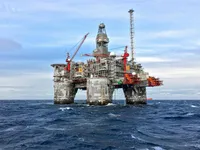
Offshore platforms. Caissons, conductor pipes and structural members stay exposed to marine corrosion throughout their service life. PEC can screen these while reducing coating removal, particularly around submerged supports.
Ships and FPSOs. Large hulls often have extensive steel surfaces requiring inspection. PEC can provide broad screening and flag areas that need detailed UT follow-up.
7. Advantages, limitations and ROV deployment
PEC has several practical benefits: inspection through suitable coatings and some marine growth, reduced surface preparation, faster screening of large areas, and compatibility with remote and robotic deployment.
That said, PEC applies mainly to ferromagnetic materials, and results can be influenced by wall thickness, geometry, lift-off, nearby welds and the size or distribution of corrosion. Highly localised defects may not be characterised accurately, so sensor stability and repeatable positioning are critical to getting usable data.
An ROV can carry PEC equipment to deep or difficult-to-access assets, combining electromagnetic inspection with visual imaging, sonar and location tracking to build a fuller record of what was detected and where.
Improving offshore asset integrity through ROV-based inspection
Corrosion rarely develops in a convenient spot. It tends to form under insulation, behind marine growth, or in sections of an asset that are hardest to reach through manual inspection. Combining screening methods like PEC with ROV-based deployment changes what an integrity programme can realistically cover, since a screening result is only useful if the same spot can be found again later for confirmation.
Protect what lies beneath the surface
Subsea assets carry risk that stays hidden until it becomes a costly repair or a shutdown. EyeROV’s underwater inspection solutions bring visibility to these conditions, using ROV platforms built for stable positioning and repeatable coverage across pipelines, platforms, hulls and other submerged structures. EyeROV’s ROVs currently support ultrasonic thickness (UT) gauging, deployed to reach the sections of an asset that are hardest to inspect by other means.
Explore EyeROV’s subsea inspection solutions and bring greater visibility to your critical offshore assets, or get in touch to discuss your inspection requirements.
Take subsea inspection further with SAGARA
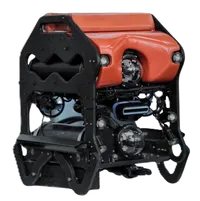
The EyeROV SAGARA is a payload-flexible ROV that can carry sensors including a DVL for navigation, a CTD for water parameter monitoring, and forward looking multibeam sonar for subsea mapping, alongside UT thickness gauging, configured to the inspection at hand.
Discover SAGARA and give your inspection team the confidence to go deeper.
Frequently asked questions
What is subsea PEC wall thickness inspection?
Testing that screens ferromagnetic subsea assets for corrosion-related wall loss, often without contact with bare metal.
What is Pulsed Eddy Current testing?
An electromagnetic method that pulses a magnetic field into a component and reads the decay of the induced currents to estimate wall thickness.
Can PEC inspect through subsea coatings?
Yes, through many suitable non-conductive coatings, provided lift-off stays within procedure limits.
Can PEC work through marine growth?
It tolerates some marine growth, but excessive or uneven deposits can affect the function.
Is PEC suitable for subsea pipelines?
Yes, for external corrosion screening where access or surface preparation is difficult.
What is the difference between PEC and ultrasonic thickness testing?
PEC screens for wall loss through difficult surfaces; UT gives direct, local readings once contact is available.
What are the limitations of subsea PEC inspection?
Geometry, lift-off, nearby structures and localised corrosion can all affect results, since PEC applies mainly to ferromagnetic materials.
Can PEC inspection be performed using an ROV?
Yes, provided the ROV and sensor interface are configured for stable, repeatable inspection.
When should PEC be used instead of UT?
For broad screening across large, coated or biofouled areas, where coating removal would be costly.
What factors should be considered when selecting a subsea NDT method?
Material type, defect pattern, coating condition, marine growth, geometry, water depth and required accuracy.