






Underwater Drones for Search and Rescue: A Mission Guide
Discover how underwater drones for search and rescue improve mission speed, safety, and recovery success with sonar, HD cameras, and precise navigation.
When a person, vehicle, or important asset is lost underwater, response teams face a race against time. Underwater drones for search and rescue are changing how these missions unfold. By putting cameras, sonar, and manipulator arms beneath the surface within minutes, remotely operated vehicles (ROVs) help teams search faster, see more clearly, and recover targets without risking divers. From the first minutes of a drowning response to complex flood operations, this guide explains how these systems work and what professional agencies should look for.
What are underwater drones for search and rescue?
Underwater drones, formally known as remotely operated vehicles (ROVs), are tethered robotic systems piloted from the surface. Fitted with high-definition cameras, forward looking multibeam sonar, powerful lights, and manipulator arms as mission payloads, they act as the eyes and hands of a rescue team beneath the waterline, even in turbid water.
In search and rescue (SAR) operations, ROVs perform three core functions: searching underwater areas for missing persons or objects, inspecting targets and hazards before recovery, and physically assisting in the recovery itself. Unlike general-purpose inspection drones, SAR-configured ROVs are set up for one job: reaching a target area fast and confirming what is there. Live video and sonar streamed to the surface let teams make decisions that once required repeated diver descents. As underwater emergencies demand faster response, ROVs have become standard equipment for modern rescue agencies worldwide.
Why underwater drones are essential for search and rescue
Speed, safety, and information define the outcome of every SAR mission, and a capable underwater ROV strengthens all three.
Rapid deployment during emergencies
Portable ROVs travel in a few rugged cases, launch from a riverbank, jetty, or small boat, and can be searching within minutes of arrival. There is no waiting, decompression planning, or specialised vessels, which shortens the critical first hour of a search.
Safer alternative to initial diver deployment
Rescue diving in dark, debris-filled, or fast-moving water is among the most dangerous jobs in public safety. Deploying an underwater drone first lets teams locate the target and assess entanglement hazards, currents, and submerged structures before any diver enters the water.
Improved situational awareness
Live video and sonar feeds give incident commanders a shared, real-time picture of the underwater scene. Instead of relying on a diver’s verbal description after each descent, the entire team can observe conditions, mark target positions, and plan the recovery with far greater confidence.
How underwater drones support search and rescue missions
From the first sonar sweep to the final lift, an ROV contributes at every stage of an underwater recovery operation.
Locating missing persons and objects
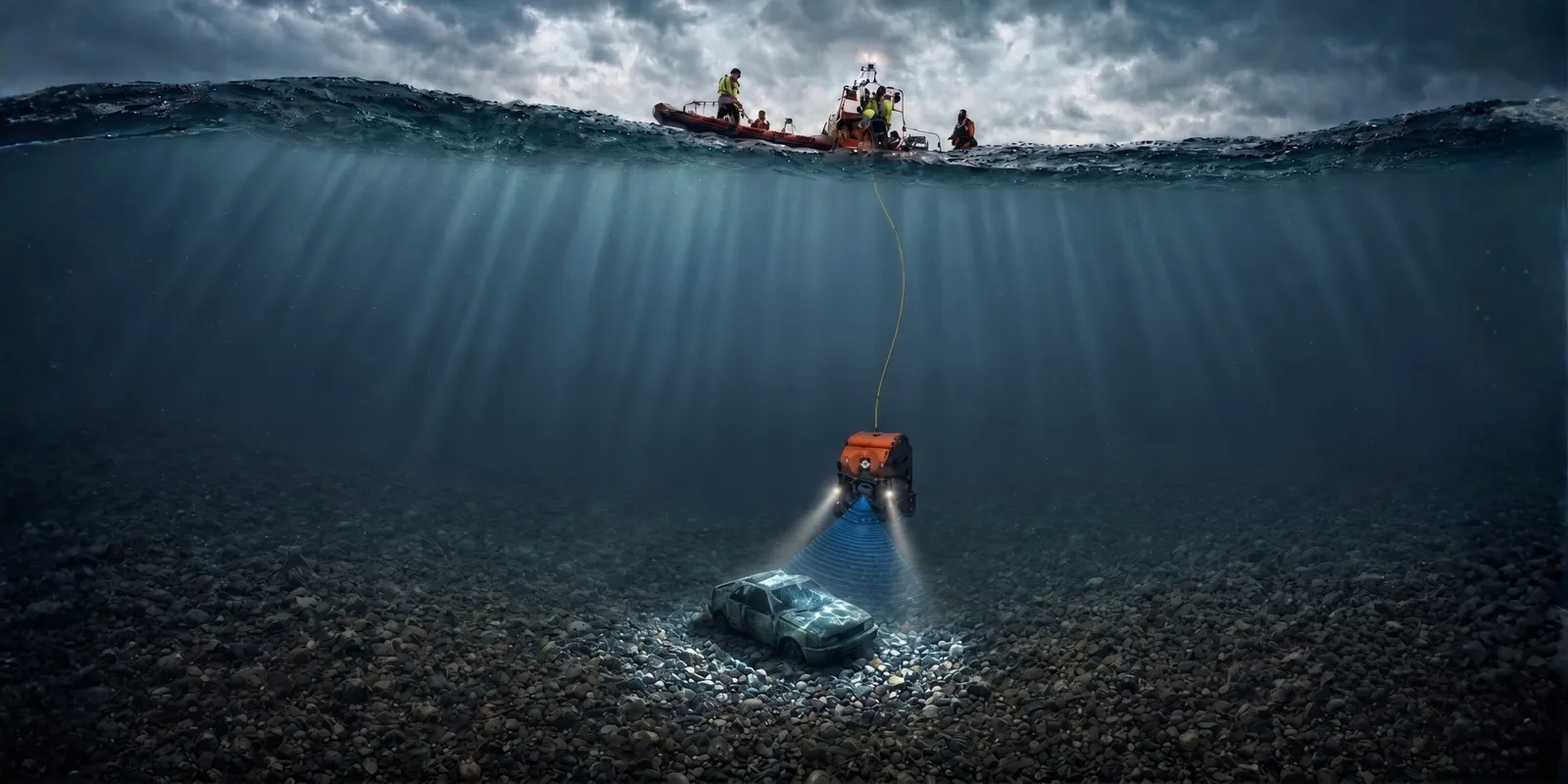
Using forward looking multibeam sonar, an ROV can sweep search grids far faster than divers working in rotation, detecting targets tens of metres away even in zero visibility. Once a contact is identified, the vehicle closes in and confirms it visually with cameras and lights.
Underwater inspection before recovery
Before recovery begins, the ROV inspects the target and its surroundings, checking for entanglement risks, unstable debris, vehicle doors, or structural hazards. This lets teams plan lift points, rigging, and diver approach paths in advance, reducing surprises during the mission’s most delicate phase.
Evidence and asset recovery operations
When the mission objective is an object rather than a person, ROVs fitted with manipulator arms retrieve items such as weapons and phones under continuous chain-of-custody video. For larger targets like vehicles, the ROV confirms position and condition so the recovery team can plan the lift with certainty.
Technologies that improve underwater search operations
A search and rescue ROV is only as capable as the sensors it carries. Four technologies do the heavy lifting in real missions.
Sonar for low-visibility navigation
Forward looking multibeam sonar builds an acoustic picture of the underwater scene, letting operators navigate, detect, and identify targets when cameras see nothing. In the silt-laden rivers, reservoirs, and harbours where most SAR missions take place, sonar is the primary search tool, not an optional extra.
High-definition cameras and live video
Low-light HD cameras paired with LED lighting provide the visual confirmation every mission requires. Live video streamed to the surface lets commanders positively identify targets, assess conditions, and record footage for post-mission review, training, and legal documentation.
Positioning and navigation systems
Acoustic positioning (USBL), Doppler velocity log (DVL), and pressure sensors work together to accurately determine the ROV’s position, velocity, and depth underwater. This information enables autonomous functions such as position holding, waypoint navigation, station keeping, and autopilot operation, while providing operators with precise real-time vehicle localisation. Precise coordinates let recovery teams return to the exact spot, even hours later in shifting conditions.
AI-powered human detection
AI models trained on sonar can automatically flag human shapes in real time, cutting down false positives from debris or fish. This helps pilots spot targets faster during long, fatigue-heavy searches, especially in low-visibility conditions.
Challenges faced during underwater search and rescue
Even with advanced tools, underwater SAR remains one of the hardest jobs in emergency response.
Murky water and limited visibility
Sediment, algae, and debris reduce visibility to near zero in the flood waters and reservoirs where most incidents occur. Modern SAR practice treats acoustic search as the primary method rather than a backup: the sonar finds the target, and cameras move in only for final confirmation.
Strong currents and environmental conditions
River currents, tidal flows, and cold temperatures challenge both the ROV and its operator. SAR-grade systems combine strong thrusters, stable control, advanced piloting functions, and dependable tether management to give operators precise control and steady positioning in demanding water where lighter consumer-grade drones would quickly lose stability.
Time-critical mission requirements
Survival windows in drowning incidents are measured in minutes, and site conditions rarely wait for a slow setup. Every element of the ROV, from transport cases and launch procedure to battery endurance and pilot workflow, must be engineered for speed under pressure.
Choosing the right underwater drone for SAR missions
Procurement teams evaluating a professional underwater drone should weigh three factors above all others.
Ease of deployment and operation
Look for a system that two people can carry, set up, and pilot confidently after short training. Intuitive controls, quick-swap batteries, and minimal surface equipment mean the ROV spends more time searching and less time on the bank.
Payload compatibility and expandability
Missions vary, and the platform should adapt with them. Support for interchangeable payloads, including forward looking multibeam sonar, manipulator arms, USBL positioning, and additional cameras, lets a single ROV serve searches, inspections, and recoveries.
Reliability in demanding environments
SAR equipment must work the first time, every time. Prioritise depth-rated, field-proven vehicles with rugged housings, dependable tethers, and responsive local service support, so the drone performs in monsoon floods, silted reservoirs, and open-sea conditions alike.
Why professional search and rescue teams choose ROVs
Across coast guards, naval organisations, police units, and disaster response forces, the operational case for ROVs is consistent.
Faster search coverage
A sonar-equipped ROV can cover a search grid several times faster than dive teams working rotation schedules, and it never needs surface intervals. Faster coverage means faster answers for families and commanders.
Reduced risk to personnel
Every dive avoided is a risk avoided. By handling initial searches, hazard assessments, and many recoveries robotically, agencies protect their divers from entanglement, hypothermia, and decompression hazards, deploying them only once conditions are fully understood.
Better mission documentation
Recorded video, sonar imagery, and positioning logs create a complete, timestamped record of every operation. It supports legal proceedings, insurance claims, after-action reviews, and training.
Strengthen search and rescue missions with professional underwater ROVs
Every search and rescue mission depends on speed, clear underwater visibility, and informed decisions. Professional underwater ROVs help emergency response teams locate, inspect, and recover underwater targets while keeping personnel out of hazardous water. As rescue operations become more demanding, dependable underwater technology decides mission outcomes.
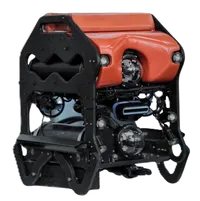
The EyeROV SAGARA is configured for SAR missions with forward looking multibeam sonar, manipulator arms, lighting, and positioning payloads, and it is deployed by teams that need live visibility and steady control in difficult water. To discuss a search and rescue requirement, contact EyeROV.
Frequently asked questions
What are underwater drones used for in search and rescue?
They locate missing persons and objects, inspect underwater scenes before divers deploy, and retrieve evidence and assets, streaming live video and sonar imagery to teams on the surface.
How do underwater drones locate missing persons?
Operators sweep search grids using forward looking multibeam sonar to detect targets acoustically, then move the ROV closer to confirm each contact visually with HD cameras and lights.
Can underwater drones operate in murky water?
Yes. Acoustic sensors such as forward looking multibeam sonar let SAR ROVs search and identify targets when optical visibility is near zero, with cameras used at close range only for final confirmation.
What technologies do search and rescue ROVs use?
Forward looking multibeam sonar, low-light HD cameras with LED lighting, acoustic positioning (USBL), depth and heading sensors, and manipulator arms carried as payloads for recovery tasks.
Why are ROVs safer than traditional diver-only searches?
The ROV performs the initial search and hazard assessment, so divers enter the water only after the target and risks are known and a recovery plan is in place.
How are underwater drones deployed during emergencies?
Portable SAR ROVs are carried in transport cases, launched from a bank, jetty, or boat by a small crew, and can be searching within minutes of arriving on scene.
What features should a search and rescue underwater drone have?
Prioritise rapid deployment, sonar and camera payload options, strong thrusters for currents, precise positioning, long endurance, and proven reliability backed by responsive service support.
Can underwater drones recover underwater evidence?
Yes. ROVs with manipulator arms retrieve items such as weapons and phones while recording chain-of-custody video, and can attach rigging lines for lifting larger objects.
Which industries use underwater search and rescue drones?
Government emergency management departments, fire and rescue services, coast guard and naval units, police dive teams, port and harbour authorities, and defence organisations.
What is the best underwater drone for professional SAR operations?
The best system is the one matched to your missions. For teams needing sonar integration, payload flexibility, and field-proven reliability, the EyeROV SAGARA is configured for demanding SAR operations.