






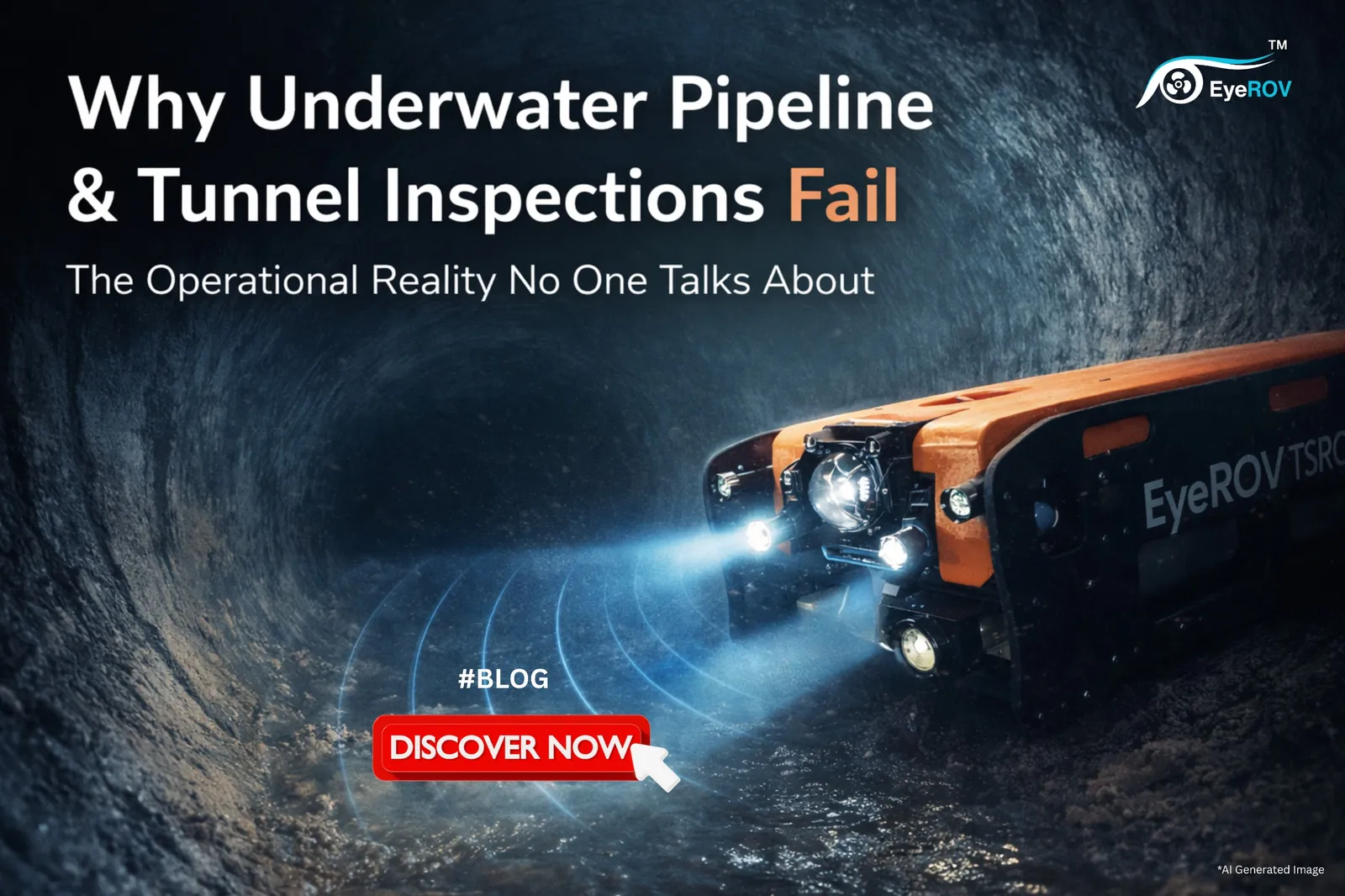
Why Underwater Pipeline & Tunnel Inspections Fail
A deep dive into why traditional underwater inspections of critical submerged infrastructure fail and how purpose-built robotic systems like EyeROV’s TSROV transform zero-visibility tunnel inspection into measurable, repeatable asset intelligence.
The Operational Reality No One Talks About
Stand at the edge of a tunnel shaft.
Beneath you lies kilometers of submerged infrastructure - unseen, aging, critical.
It carries drinking water.
It feeds turbines.
It discharges industrial outfalls.
It transports sewage beneath cities.
It diverts floodwaters during storms.
It cools thermal and nuclear power plants.
You cannot drain it.
You cannot stop it.
You cannot enter it safely for long.
Yet you are expected to certify its integrity.
This is where underwater inspection stops being procedural, and becomes operational.
And this is where inspections quietly fail.
The Visibility Illusion
Most pipeline inspection frameworks are built around visibility.
“If we can see it, we can assess it.”
But submerged infrastructure does not cooperate.
-
Suspended sediment reduces visibility to zero.
-
Flow churn stirs silt into opaque clouds.
-
Light scattering makes cameras unreliable.
-
Disturbance from entry itself degrades clarity.
In sewage tunnels and wastewater systems, visibility is often permanently zero.
In cooling water tunnels, biofouling clouds optics.
In stormwater systems, post-flood sediment turns inspection into guesswork.
In many real-world conditions, visual inspection becomes an assumption.
This is why inspection systems must be engineered for zero-visibility environments, not ideal ones.
Access Is Not Coverage
A 1-meter shaft opening does not mean a 5-kilometer tunnel is inspectable.
Inside submerged systems:
-
Distance exceeds diver endurance.
-
Flow restricts upstream movement.
-
Retrieval becomes complex.
-
Documentation becomes inconsistent.
-
Fatigue affects decision quality.
This applies not just to water conveyance tunnels, but also to:
-
Hydropower headrace and tailrace tunnels
-
Large-diameter sewage conveyance tunnels
-
Stormwater flood diversion tunnels
-
Marine intake and outfall systems
-
Industrial process tunnels
Partial inspection creates false confidence.
You may inspect 800 meters of a 9-kilometer system and leave believing you’ve seen enough.
But unseen defects accumulate silently.
The Dewatering Myth
Draining a tunnel sounds ideal.
But in practice, dewatering often means:
-
Operational shutdown.
-
High pumping and energy cost.
-
Structural stress risk.
-
Regulatory coordination.
-
Loss of service continuity.
For hydropower plants, wastewater utilities, desalination facilities, and industrial operators, stopping flow is rarely acceptable.
Stormwater tunnels cannot be dewatered mid-season.
Sewage tunnels cannot simply be emptied without city-scale impact.
Cooling water tunnels cannot interrupt generation cycles.
So inspection must adapt to the infrastructure, not the other way around.
Where Robotics Redefine the Equation
This is where purpose-built submerged robotics enter the picture.
Not generic ROVs.
Not diver substitutes.
But systems engineered specifically for long, confined, submerged infrastructure.
The TSROV: Designed for Long-Distance Submerged Infrastructure
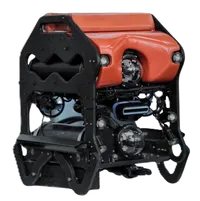
EyeROV’s TSROV (Tunnel Specialist ROV) is built around one core reality:
Submerged infrastructure is long.
And access points are few.
Key operational capabilities include:
-
Up to 10 km tether range from a single entry point
-
Operational depth up to 450 meters
-
24+ hours continuous endurance
-
Robust tether communication for extended-range missions
This fundamentally changes inspection feasibility.
Instead of staggered deployments, partial coverage, or multiple access excavations, TSROV enables continuous structural mapping across kilometer-scale infrastructure whether it is:
-
A hydropower headrace tunnel
-
A sewage trunk tunnel beneath a city
-
A stormwater diversion tunnel
-
A cooling water intake system
-
A marine outfall
-
A dam diversion tunnel
The platform is not limited to “tunnels.”
It is built for confined submerged infrastructure intelligence.
Seeing Without Seeing: Multi-Sensor Architecture
TSROV is not dependent on visibility.
It integrates:
-
Multibeam Forward Looking Multibeam Sonar for structural visualization in zero visibility
-
360° 3D Mapping Sonar for cross-sectional mapping
-
Laser Scalers for dimensional measurement
-
Doppler Velocity Log (DVL) for localization
-
Multi-camera systems for visual confirmation
-
High-intensity LED arrays
In clear water, optical systems assist.
In turbid sewage environments, acoustic systems lead.
In biofouled cooling tunnels, 3D mapping sonar reveals geometry.
Inspection no longer fails when visibility disappears.
Structured Survey, Not Random Exploration
Inspection failure often occurs not because of hardware limitations, but because of unstructured methodology.
TSROV missions follow defined survey patterns:
-
Parallel scanning for full cross-sectional coverage
-
Overlapping data acquisition for redundancy
-
Continuous longitudinal profiling
-
Real-time monitoring via control station
The result is not just footage.
It is:
-
Full structural profile mapping
-
3D digital reconstruction
-
Siltation volume estimation
-
Point cloud datasets
-
Localized anomaly identification
Whether inspecting a sewage trunk line or a 9 km hydropower tunnel, the principle remains the same:
Coverage must be complete.
Data must be measurable.
Results must be repeatable.
From Footage to Intelligence: The Data Layer
Another silent failure in underwater inspection is reporting quality.
Hours of video do not equal insight.
In wastewater systems, corrosion progression must be tracked.
In stormwater tunnels, deformation after flood events must be quantified.
In hydropower tunnels, Silt Level Measurement must be made.
EyeROV’s EVAP (EyeROV Visualization & Analytics Platform) transforms raw TSROV data into:
-
3D digital models
-
Enhanced imagery from hazy environments
-
AI/ML-based defect detection
-
Criticality-based analytics reporting
-
Cloud-based visualization dashboards
Structural Integrity Inspection evolves from documentation to asset intelligence.
And intelligence enables preventive maintenance, not reactive repair.
Real-World Performance
TSROV has been deployed in long-distance tunnel inspections including multi-kilometer hydropower tunnels and outfalls, delivering:
-
Kilometer-scale coverage
-
Continuous sonar-based structural profiling
-
Siltation mapping
-
Structural anomaly identification
-
Consolidated engineering reports for authorities
The difference is not theoretical capability, but operational execution
But Robotics Are Not Magic
Even advanced systems face constraints:
-
Flow thresholds must be respected.
-
Debris-dense zones require navigation planning.
-
Tether management demands operational discipline.
-
Geometry transitions must be assessed beforehand.
Technology does not eliminate engineering judgment.
It amplifies it.
The real shift is toward deployment criteria, understanding when long-range robotic systems like TSROV are the optimal tool for safety, coverage, and data fidelity.
Why Inspections Truly Fail
Underwater inspections fail when:
-
Visibility is assumed.
-
Access is mistaken for coverage.
-
Reports are subjective.
-
Data is not quantifiable.
-
Repeatability is absent.
-
Safety is compromised.
They fail when inspection is treated as compliance , instead of an engineering intelligence exercise.
The Reality Check
Submerged infrastructure is aging globally.
Hydropower tunnels built decades ago.
Urban sewage systems beneath expanding cities.
Stormwater tunnels facing more extreme weather events.
Industrial cooling tunnels under continuous load.
Blind spots are no longer acceptable.
Inspection must evolve from:
Observation → Measurement
Video → Mapping
Footage → Analytics
Presence → Intelligence
Systems like TSROV represent that shift, engineered for the operational realities of long, submerged, confined infrastructure across energy, water, wastewater, and industrial sectors.
Because in underwater inspection, the real failure is not what you find.
It is what you never saw.