





ROV Inspection: How Underwater Robots Inspect Assets
ROV inspection uses tethered underwater robots to assess dams, pipelines, ship hulls, and offshore assets without divers. Learn how it works and where it fits.
Submerged assets fail in places that are hard to see and hard to reach, at depths or inside confined spaces that are difficult to access. ROV inspection is the use of a tethered, remotely operated underwater vehicle, piloted from the surface, to visually and instrumentally assess submerged assets such as dams, pipelines, ship hulls, and offshore platforms. At EyeROV, we use it to reach those places and provide both a live view during the inspection and recorded data afterwards, all while the asset stays in service. This guide explains what ROV inspection is, how it works, where it is used, and when it is the right tool.
What is an ROV inspection?
An ROV is a compact underwater robot connected to the surface by a tether that carries power down and data back. In an inspection, the ROV pilot flies it across the asset and records what it sees and measures. That can mean high-definition video, forward looking multibeam sonar where the water is murky, ultrasonic thickness readings on steel, sediment and scour surveys, and structural assessment of cracks, corrosion, and weld condition.
It is preferred over diver-based or dewatering methods for three reasons. The first is safety, because the work is done without entering deep, cold, contaminated, or confined water. The second is cost, because the asset stays in service rather than being drained or shut down. The third is data quality, because every survey produces recorded video and sensor logs that can be reviewed later and compared against the next inspection.
How an ROV inspection works
An ROV inspection runs from planning through to a written report, and each stage sets up the next.
Pre-deployment planning
We start by confirming what is being inspected, how deep it sits, the visibility to expect, and the access point. That decides the sensor payload, whether the job needs a camera only, forward looking multibeam sonar for low visibility, or an ultrasonic gauge for wall thickness on steel.
Deployment and survey
The operator lowers the vehicle from the bank, deck, or boat and pilots it across the asset along a pre-planned path or grid. Live video streams to the surface while every frame is logged with a timestamp and position coordinates, so any finding can be located again precisely.
Findings and reporting
The survey produces high-definition video, sonar mosaics where visibility is low, and measurement data. We review it and deliver a written report that flags anomalies, including cracks, corrosion, scour, sediment build-up, biofouling, and debris, each tagged to its location for follow-up.
Where ROV inspections are used
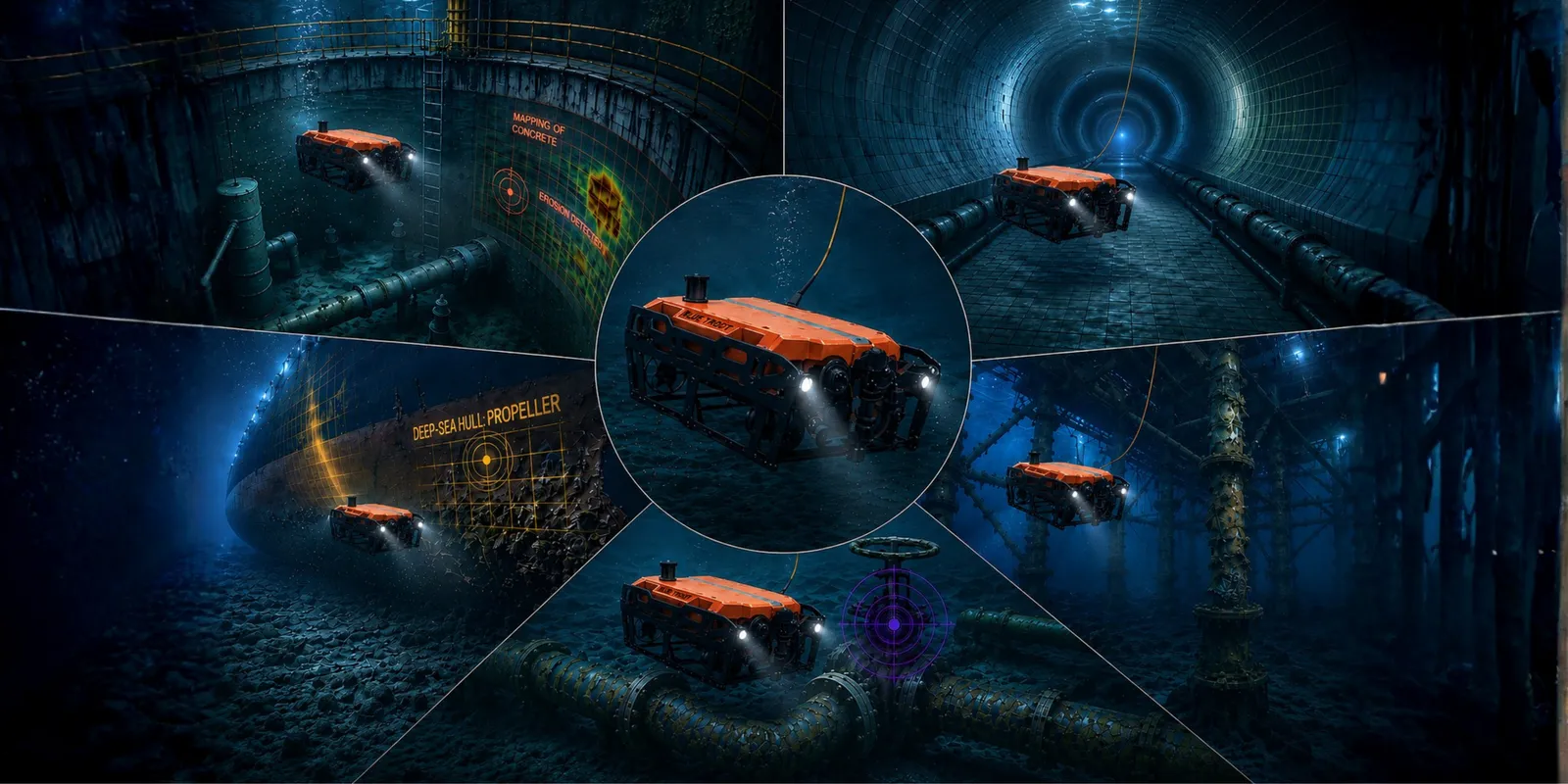
An underwater ROV inspection works across sectors because the same core capability, reaching submerged structures that are deep, confined, or otherwise hard to access, applies whether the asset is a dam, a pipeline, a ship hull, or an offshore platform. Each deployment is backed by power, a trained crew, tether handling, and topside hardware.
Dam and reservoir inspection
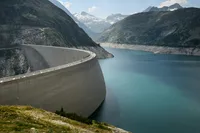
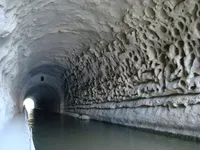
Below the waterline, an ROV covers the upstream face for cracks and spalling, gate seals and trash racks, intake and outlet works, penstocks and tunnels, and sediment or scour near the toe. Draining a reservoir to check these can cost weeks of lost generation, while an ROV works at full pool in days. See our underwater dam inspection services.
Pipeline inspection
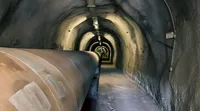
Pipelines fail at points hidden under water or seabed, most often as coatings age and corrosion sets in. An ROV inspection checks for external corrosion, coating damage, free spans, and leaks, confirms that buried sections stay covered, and measures wall thickness with ultrasonic sensors. It suits subsea oil and gas lines and inland water-supply mains. See our underwater pipeline inspection services.
Ship hull and maritime inspection
On vessels, an inspection covers the hull for biofouling and coating breakdown, reads weld condition, and examines propellers, rudders, and sea chests. Much of this supports UWILD, the Underwater Inspection in Lieu of Drydocking, which lets a ship be surveyed afloat to classification society standards and saves the cost and lost trading days of a dry dock. Read our guide to ship hull inspection or see our maritime ROV services.
Offshore oil and gas inspection
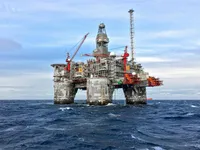
Offshore structures sit far below the surface and often run past their design life. An ROV inspection covers risers, jackets, caissons, anchor chains, FPSO hulls, and ballast tanks, looking for fatigue cracking, corrosion, and metal loss at load-bearing welds. The splash zone, where waves meet the steel, is among the hardest areas to reach, and risk-based programmes rely on this repeatable data. See our offshore oil and gas inspection services.
When ROV inspection is the right choice
ROV inspection is the clear answer in four situations. The first is when the asset cannot be drained or shut down without major revenue loss, such as a producing pipeline or a dam at full pool. The second is when depth goes beyond safe sustained diver range. The third is when the environment is hazardous, including contaminated water, confined spaces, low temperature, or strong current. The fourth is when repeat inspections need identical positioning so the same asset can be compared year on year.
It also has limits, and we are clear about them. Tasks that need fine manipulation can sit beyond what current ROV arms handle, and some zero-visibility conditions where even sonar resolution is limited may call for a hybrid diver and ROV approach. For most submerged inspection and condition monitoring, though, the ROV is the practical choice.
What an ROV inspection report includes
A complete inspection delivers timestamped HD video, an anomaly log with location coordinates, sonar imagery or photo mosaics where applicable, measurement data, and a written report with recommendations. Our inspections also feed into EVAP, our visualisation and analytics platform. EVAP converts survey data into two and three-dimensional models and sharpened imagery, brings the outputs together in one place, and supports year-on-year comparison of the same asset so owners can forecast repairs rather than react to failures.
Why choose EyeROV for ROV inspection
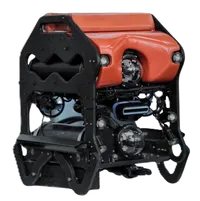
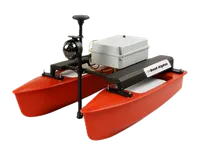
We design and build our ROVs in India, so the EyeROV TUNA, EyeROV SAGARA, and TSROV are supported in the country without a wait for overseas parts. They are inspection-class vehicles rated for different working depths, covering most dam, pipeline, hull, and inshore work. On a recent dam project, we surveyed the upstream face and gate structures at full pool using the TUNA with an HD camera and laser scaling, and delivered a tagged condition report with no drawdown. Our vehicles work alongside divers and engineers, taking the deep and confined reach while the team handles hands-on tasks, and our ROV inspection services run across defence, oil and gas, hydropower, ports, and maritime work. To learn the basics first, read What is ROV, or to plan an inspection, contact EyeROV.
Frequently asked questions
What is ROV inspection?
ROV inspection is the use of a remotely operated underwater vehicle to visually and instrumentally assess submerged assets. An operator pilots the tethered robot from the surface, recording HD video, sonar data, and measurements. It is used on dams, pipelines, hulls, and offshore platforms instead of divers or dewatering.
How deep can an ROV inspect?
Depth depends on the class of ROV. Compact inspection-class systems suit shallow to mid-water work, while work-class vehicles are built for far greater depths. EyeROV’s TUNA and SAGARA are inspection-class vehicles rated for the depths involved in most dam, pipeline, hull, and inshore oil and gas inspections.
Is ROV inspection cheaper than diver inspection?
For most submerged assets, yes. ROVs remove diver standby, surface decompression, and asset shutdown costs. A dam inspection that once needed weeks of drawdown can be completed in days at full pool. Exact savings depend on asset size and depth, but the reduction is usually substantial.
What can an ROV inspection detect?
Cracks, corrosion, coating breakdown, biofouling, structural deformation, sediment build-up, scour, debris, weld defects, and leaks. With ultrasonic sensors, ROVs also measure wall thickness on steel pipes and gates, and sonar adds detection in low-visibility water where cameras fall short.
How often should ROV inspections be done?
Frequency depends on asset risk, regulator and class requirements, and environment. Dams are typically inspected every one to five years, ship hulls follow UWILD cycles, and pipelines and offshore assets in active service are inspected annually or after any incident. We can advise based on the asset class.