



ROV Tank Inspection Explained: Visual Checks and UT Readings
See how an ROV inspects water and fire water tanks without draining them, with HD video, laser scaling, UT thickness readings and sonar sediment mapping.
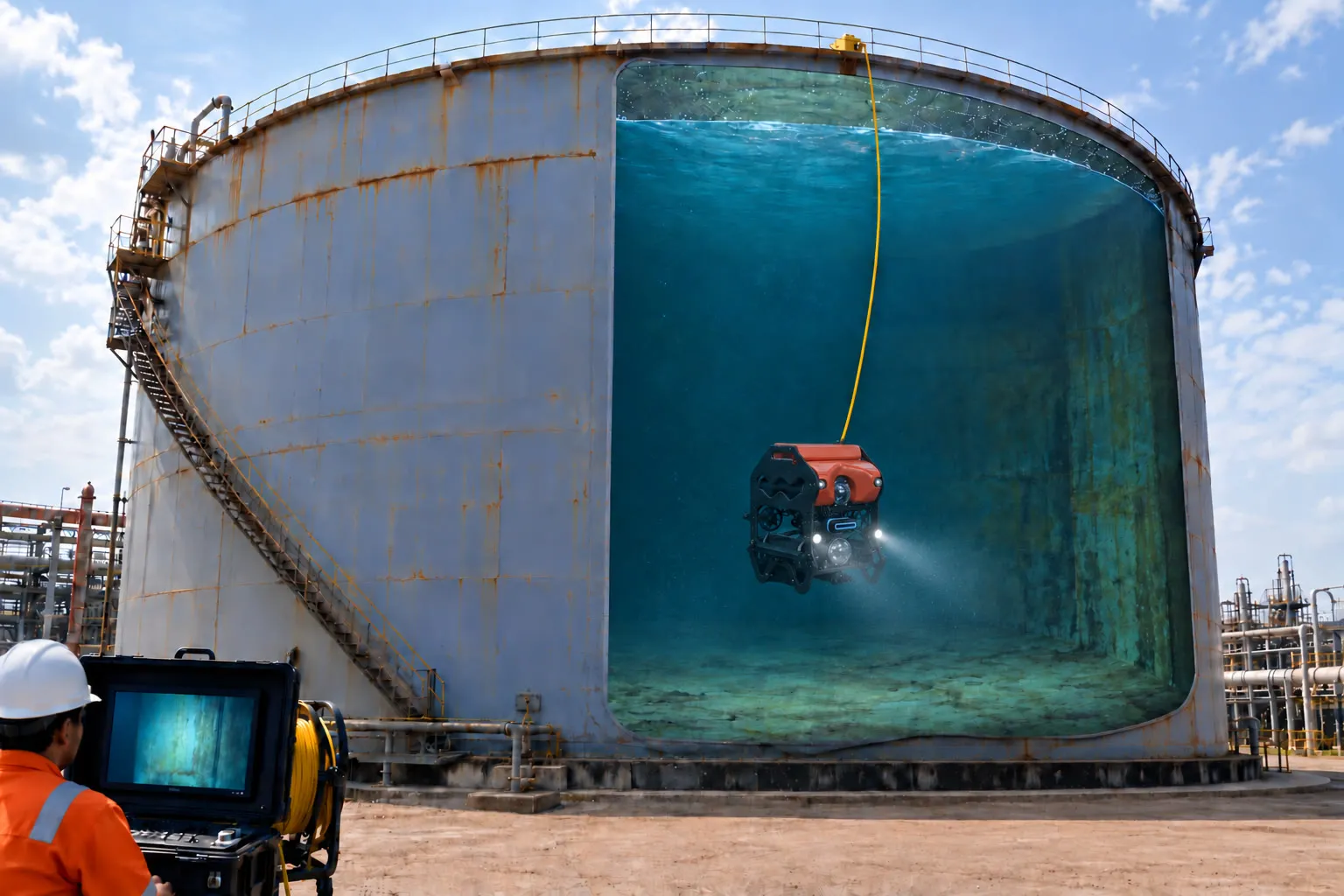
Most industrial sites keep large tanks of water. Refineries and power plants store raw, process, cooling and fire water so they never run short. A typical fire water tank holds about 95 to 950 m³, and the largest steel tanks hold around 13,000 m³. Most tanks are welded or bolted steel, and some are concrete. Over time, the inside wears out. The coating peels and the walls get thinner, but this cannot be seen from outside. Checking usually means draining the tank, which takes it out of use and, for a fire water tank, cuts fire protection. ROV tank inspection avoids this. An underwater vehicle goes in through the roof and checks the tank without draining it. This guide explains what that check covers.
What is ROV tank inspection?
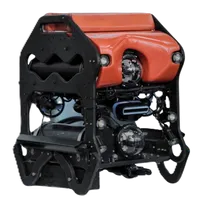
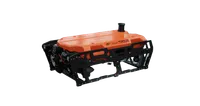
ROV tank inspection is a survey of a tank’s interior using a small tethered remotely operated vehicle. The vehicle goes in through an existing roof manhole or hatch. An operator at the top navigates the ROV along the shell and floor while it records video, and with other payloads measures steel thickness, cracks, leakages, silt deposits and corrosion. The biggest advantage of using an ROV is that the inspection can be done while the tank is full.
Tanks that suit an ROV survey
On industrial sites that usually means raw water, process water, demineralised and service water tanks, in steel or concrete. Refineries and power plants hold many of these, which is why tank surveys sit alongside our oil and gas inspection work.
Fire water and sprinkler tanks
Fire water tanks carry an extra constraint. They must stay full so the fire system can draw on them at any moment. Draining one for inspection reduces the site’s fire cover unless a backup supply is arranged. An in-tank ROV survey avoids that problem, because the water level never has to drop. This makes fire water and sprinkler tanks one of the clearest cases for surveying in place.
A survey is a poor fit for tanks holding flammable or hydrocarbon products, and for tanks where heavy sludge or a small opening keeps the vehicle out.
What condition is the inside in?
The camera survey comes first and covers the whole interior. Lights on the vehicle cut through the dark water while the HD cameras record each zone in turn:
- the roof underside, with the camera tilted upward
- shell courses and weld seams, from top to bottom
- the shell-to-floor junction, where sediment often gathers
- floor plates and any visible pitting
- nozzles, inlets, outlets, ladders and internal supports
Video shows that a defect exists. It does not show how large it is. For that, the vehicle can carry a laser scaler as a payload, which measures the length of a crack or other defect. On a seawater intake well inspection, EyeROV used this approach to record the length and width of each defect, even in turbid water.
How much steel is left?
Visible damage and thickness loss do not always match. A shell can look sound under its coating but may have thinned inside. That is why the survey moves on to ultrasonic thickness (UT) gauging.
The UT probe is a payload. The pilot holds it against a plain surface on the steel, and the ultrasonic echo from the probe gives the thickness value. The readings from the inspection are compared against the nominal thickness on the tank drawings. Our underwater NDT testing guide explains the method in more depth.
How much sediment has settled?
Sediment builds up on tank floors over time, reducing visibility and covering the floor plates. An ROV equipped with forward looking multibeam sonar can inspect the tank even in murky water, recording where silt has accumulated and how far it extends across the floor. Comparing these records between surveys helps the owner track changes in sediment build-up and plan cleaning.
Can the next survey find the same spots?
The first ROV survey establishes a baseline of the tank’s condition, capturing thickness readings, inspection footage and key observations. The team can organise this data in a visualisation and analytics platform and provide the client with a detailed inspection report.
During subsequent surveys, readings taken at the same locations can be compared with the earlier records. The client receives comparative findings showing changes in steel thickness and tank condition, helping them track deterioration and plan maintenance.
One tank inspection, start to finish
The process begins with a site visit, and the engineers also review the tank drawings shared by the client and assess the inspection requirements. Based on the tank’s layout, access and scope of work, the team suggests a suitable ROV and equips it with the required cameras, sonar or other inspection payloads.
During the inspection, a live feed allows the engineers and asset owner to view findings as the survey progresses. Afterwards, the team reviews the collected data and prepares a detailed report with inspection observations, images and measurements. Using a visualisation and analytics platform, the team can overlay relevant data on the footage and enhance visuals to help the client review the findings and plan follow-up work.
Frequently asked questions
How does an ROV camera help in tank inspections?
Lights and HD cameras record every zone of the tank interior. A laser scaler fitted as a payload puts a size reference on screen, and a visualisation and analytics platform improves the visuals after the survey so the report images are easy to interpret.
What does a remotely operated vehicle thickness gauge report?
It gives a steel thickness value at each cleared point on the shell or floor, logged with its location using the position tracking and UT gauge payloads.
Is an ROV survey suitable for fire water tanks?
Often, yes. Fire water tanks must stay full on standby, and an ROV works with the water level unchanged. The tank stays ready for use while the owner gets condition and thickness data.
Plan your tank survey
Share your tank details and drawings with our team, and we will scope a survey around the four questions above. Contact EyeROV to get started.